

The world of search optimization is undergoing a dramatic transformation. For decades, SEO (Search Engine Optimisation) has been the backbone of digital marketing, helping businesses rank higher in search engine results. However, with the rapid evolution of artificial intelligence (AI) and changing user behaviors, new forms of optimisation are emerging — AEO (Answer Engine Optimisation) and GEO (Generative Engine Optimisation).
In this blog, we’ll explore AEO vs SEO vs GEO, highlight their differences, and explain how they shape the future of SEO with AI. By understanding these models of AI search optimization, businesses can create smarter strategies to stay visible in the fast-changing digital landscape.
Table of Contents
- What is SEO?
- What Does AEO Stand For?
- What is GEO?
- Why GEO Matters in 2026
- SEO vs AEO vs GEO: Key Differences
- SEO vs AEO: Which is More Important?
- SEO vs GEO: In What Ways Are the Two Distinguished?
- AEO vs GEO: The New Fight
- Future of SEO with AI
- Practical Steps to Adapt to SEO, AEO, and GEO
- Case Study Example
- Common Mistakes to Avoid in the New Search Era
- Conclusion
What is SEO?
SEO (Search Engine Optimization) is the process of improving a website’s content, structure, and technical setup to rank higher on search engine results pages (SERPs). The ultimate goal is to attract more organic traffic and establish authority in the niche.
Key Elements of SEO:
- On-page SEO: Content internal linking and optimisation.
- Off-page SEO: Authority domain brand mentions and backlinks.
- Technical SEO: Characteristics like structured data and crawlability, mobile-friendliness, and site speed.
- SEO Content: Publishing content that is worthwhile, relevant, and useful.
While traditional SEO has focused on ensuring site visibility in Google’s search results, there is a shift now that users also want AI-driven data and insights.
What Does AEO Stand For?
AEO is the practice of content optimisation for direct inclusion in answer engines like Bing AI, Google’s Featured Snippet, or ChatGPT. The objective is no longer just about ranking for clicks; rather, it is about direct answers that AI or search engines use in their responses.
Characteristics of AEO
- Supports long-tail keywords and conversational search.
- Optimises content for AI assistants and voice search.
- Focuses on tight answers and enhanced structured data.
- Boosts visibility in position zero (featured snippets).
A business with AEO is not simply a site that a person may or may not click on; they are an Answerer, and their objective is to be the primary source of the answer.
Example: When someone asks Google Assistant, “What’s the best time to post on Instagram?”, AEO ensures your answer is the one AI reads aloud.
What is GEO?
As with any market, new products and services emerge, and so do new optimisation approaches to these products and services. GEO is the latest to the optimisation market. It deals with optimising content for the AI-driven generative tools like ChatGPT, Gemini by Google, and Microsoft Copilot. These tools not only provide links, but they also generate conversational summaries from multiple sources.
Key Aspects of GEO:
- There is an “AI search optimisation” aspect to GEO where answers are generated instantaneously.
- There is a “real-time, authoritative, and up-to-date content” requirement.
- GEO emphasises semantic depth and subject mastery over simple keyword stuffing.
- It enables companies to appear within the LLMs' AI-generated responses.
To sum up, the purpose of GEO is to pivot for an optimisation approach where AI systems, as opposed to just search engines, are the sources of information.
Example: When a user asks ChatGPT, “Explain SEO vs AEO vs GEO,” it synthesizes multiple sources GEO ensures your content becomes part of that synthesis.
Why GEO Matters in 2026
As AI tools increasingly replace traditional search habits, businesses that don’t optimize for generative AI will lose discoverability. GEO ensures your brand remains visible not just on Google, but inside AI chat platforms where future users will spend their time.
SEO vs AEO vs GEO: Key Differences
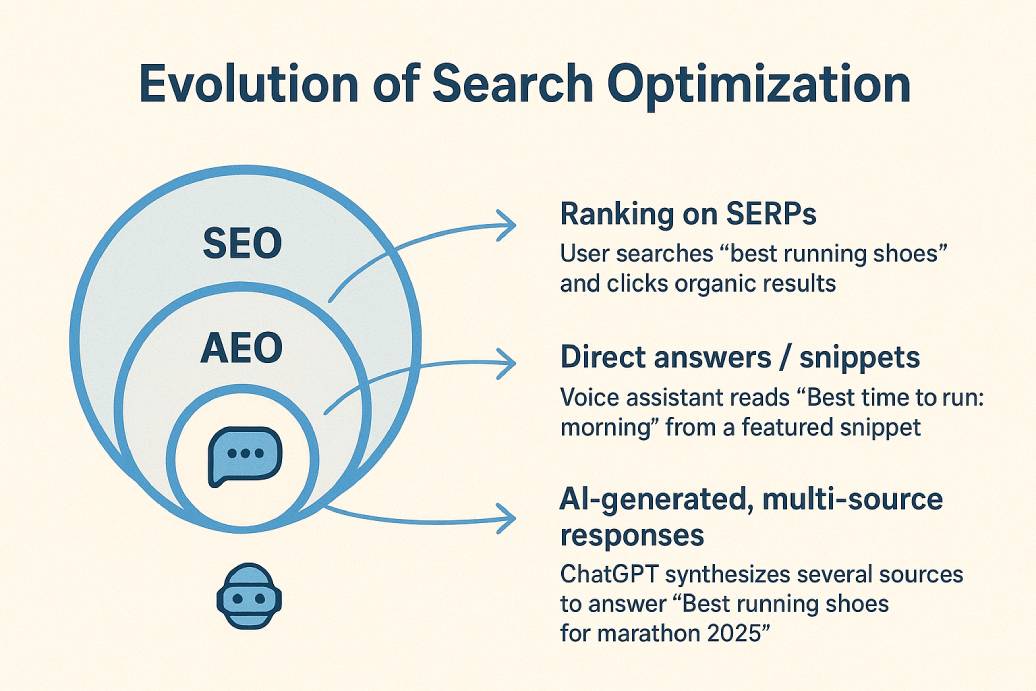
When formulating a strategy, it is paramount to understand AEO vs SEO vs GEO for derivatives of each. Although they overlap in parts, each has distinctly different objectives and means.
| Factor | SEO | AEO | GEO |
|---|---|---|---|
| Goal | Get ranked on SERPs | Get ranked as the direct answer | Get included in AI conversation |
| User Intent | Discover information through hyperlinks | Receive prompt answers | Receive AI-generated conversational insights |
| Optimisation Focus | Keywords and backlinks, site performance | Structured data and highlighted snippets, FAQs | Authority, depth, and semantic relevance |
| Platforms | Google, Bing, and Yahoo | Google snippets and voice assistants | AI applications (ChatGPT, Gemini, Copilot) |
| Data Dependency | Web crawling | Structured snippets and markup | AI models + verified, updated datasets |
| Future Relevance | Still critical | Increasingly significant | Growing necessity |
Thus, the table illustrates that the future of SEO with AI will be through the successful integration of all three strategies. The best strategy integrates all three: SEO for visibility, AEO for instant answers, and GEO for AI inclusion.
SEO vs AEO: Which is More Important?
In the case of SEO vs AEO, both strategies are equally important.
- SEO is useful in making your site available on search engines, increasing the number of clicks, and generating traffic in the long term.
- AEO focuses on making the content more AI-friendly so that your snippets and voice content have the chance of being direct answers.
For instance:
- When a user searches for “best tmt bars in India” on Google, SEO makes sure your brand is on the first pages.
- When a user searches for “Which are the best TMT bars in India” using the voice feature, AEO makes sure your information is the one that is read out.
Hence, AEO further develops SEO, helping businesses get ready for interactional and direct answer searches.
SEO vs GEO: In What Ways Are the Two Distinguished?
The controversy of SEO vs GEO illustrates the advancement of digital marketing.
- SEO is aimed at obtaining a presence on search engines.
- GEO, conversely, is aimed at obtaining a presence and being an authoritative source for AI engines.
For instance:
- SEO makes sure that your article for “climate change” is available on Google’s SERPs.
- GEO makes sure that whenever a user prompts ChatGPT with “What are the causes of climate change?”, the user’s article is part of the answer that is generated.
In a nutshell, GEO is the next advancement in SEO with the integration of generative AI.
AEO vs GEO: The New Fight
AEO vs GEO is a heated conversation as businesses start to get ready for the AI-first search era.
- AEO makes sure that content is tailored to answer specific questions for search engines like Google.
GEO goes a step further by developing resources for AI-generated, multi-source responses.
Take, for example:
- AEO gives a direct snippet to the question “What is SEO?”.
- GEO sets ChatGPT to explain “What is SEO, AEO, and GEO, and how do they differ”? in a contextual elaboration.
Thus, AEO focuses on short, precise answers while GEO focuses on comprehensive, AI-ready content.
Future of SEO with AI
The future of SEO with AI is in the integration of all three approaches. Traditional SEO is not going to die, but its function will change with AI search optimisation taking the lead.
Trends Shaping the Future:
- Conversational Search: AI systems understand natural language better than they do keywords.
- Personalisation: AI will provide results based on individual user needs.
- Multi-Source Aggregation: GEO captures your content for inclusion in AI summaries.
- Voice and Visual Search: AEO has a major role in the content adaptation for voice assistants and smart devices.
- Authority Over Keywords: The use of AI gives preference to context and expertise over exact phrases.
Companies with a first mover advantage to AEO vs SEO vs GEO will secure a competitive advantage in the emerging digital world.
Practical Steps to Adapt to SEO, AEO, and GEO
If you'd like to prepare your company for the ever-changing world of search optimisation, here are some ideas:
1. Build Topical Authority
- Create pillar pages with supporting articles on key topics.
- Use internal linking to provide context and associate articles.
2. Optimise for Natural Language
- Target long-tail phrases and more natural-sounding queries.
- Answer real user questions in your FAQ pages.
3. Improve Content Structure
- Headings, bullet points, and tables are your friends.
- To structure definitions and how-to is to provide clarity.
4. Update Content Frequently
- Your content should contain the latest statistics and trends.
- Update pages that are more than a few years old for authority and trust.
5. Help Build Enduring Brand Authority
- Publish insights that are backed by solid research.
- Be cited in high-value author publications.
- Build a reputation that can be recognised by AI systems.
6. GEO Readiness
- Write complete AI-optimised articles on a pertinent issue.
- Go beyond keywords and add semantic context.
Case Study Example
Imagine a nutrition website:
- With SEO, their blog ranks on Google for “best diet for weight loss.”
- With AEO, their content appears as the featured snippet answering, “What is the best weight loss diet?”
- With GEO, when users ask ChatGPT, “What is the best diet for weight loss in 2026, and why?”, the AI references their blog in its generated explanation.
This demonstrates how SEO, AEO, and GEO work together to maximise visibility across traditional and AI-driven platforms.
Common Mistakes to Avoid in the New Search Era
- Relying only on SEO without preparing for AEO or GEO.
- Producing thin content that lacks depth and authority.
- Ignoring structured data and schema markup.
- Neglecting content updates, outdated information reduces AI trust.
- Overusing keywords without focusing on semantic value.
Conclusion
The future of digital visibility is no longer limited to SEO alone. Businesses must adapt to a broader framework, SEO vs AEO vs GEO, to remain competitive.
- SEO ensures visibility in traditional search engines.
- AEO prepares your content for direct, AI-powered answers.
- GEO optimises content for generative engines like ChatGPT and Gemini.
As the future of SEO with AI unfolds, brands that embrace AI search optimization will dominate both human-driven and AI-driven search environments. The smartest strategy isn’t choosing between SEO vs AEO vs GEO, but integrating all three to build a future-ready digital presence.
Strengthen your AI-driven presence with DO Communication, the leading SEO agency in Gurgaon, to get your brand AI-ready for 2026 and beyond.
