

Recent advancements in AI have fundamentally altered the way we conduct online searches. Rather than typing in short requests, consumers are posing longer questions, and in turn, are expecting the answers they receive to be just as detailed. For marketers, this shift allows for the targeting of low competition keywords that are more closely aligned with the actual intention of the searcher, rather than targeting broad, generic keywords.
Learning low competition keywords and finding low competition keywords are critical to building topical authority, determining the ranking speed of a site, and driving qualified traffic in an AI search ecosystem. Along with the proper strategic content development, low competition keywords with high traffic and low difficulty keywords can provide an ongoing source of organic traffic for businesses without having to bid against the numerous competitors in the space.
Table of Contents
- What Are Low-Competition Keywords?
- The Importance of Low Competition Keywords in AI Search
- Low and High Competition Keywords
- Ways to Discover Keywords with a Low Level of Competition
- Using AI for Determining Possible Low Competition Keywords
- The Search Volume and the Level of Difficulty
- Utilizing Low Intent Keywords to Build Content
- Finding Low-Competition Keywords: Advanced Tactics
- The Most Common Mistakes When Identifying Low Competition Keywords
- Success Measurement for Low-Competition Keywords
- Emerging Trends for Keyword Research in AI Search
- Conclusion
- FAQs About Low Competition Keywords
What are Low-Competition Keywords?

Search terms with lower competition are those where there is less than the average number of competing pages for that term. These keywords are often more likely for a searcher to result in a searcher finding a desired answer to their question.
Important features of low-competition keywords
• Lower scores in keyword difficulty
• Fewer ever-authoritative rivals
• Exclusively clear user intent
• More than enough conversion opportunities
Smaller sites increase their visibility faster using keywords with less competition than highly contested ones.
The Importance of Low Competition Keywords in AI Search
Search engines based on AI keep learning and are able to understand meaning, context, and intent instead of just keywords, which makes fewer general terms preferable over long ones. For instance, rather than just looking for websites that are related to artificial intelligence, showing specific examples, such as AI search engines, would yield better results.
Advantages of using low competition keywords
• Increased likelihood of ranking faster
• Improved fit with conversational queries
• Increased engagement
• Enhanced topical authority
• Sustainable organic growth
Low difficulty keywords are a great way to achieve all of the above since AI models give preference to accurate and contextually focused content.
Understanding Low vs High Competition Keywords
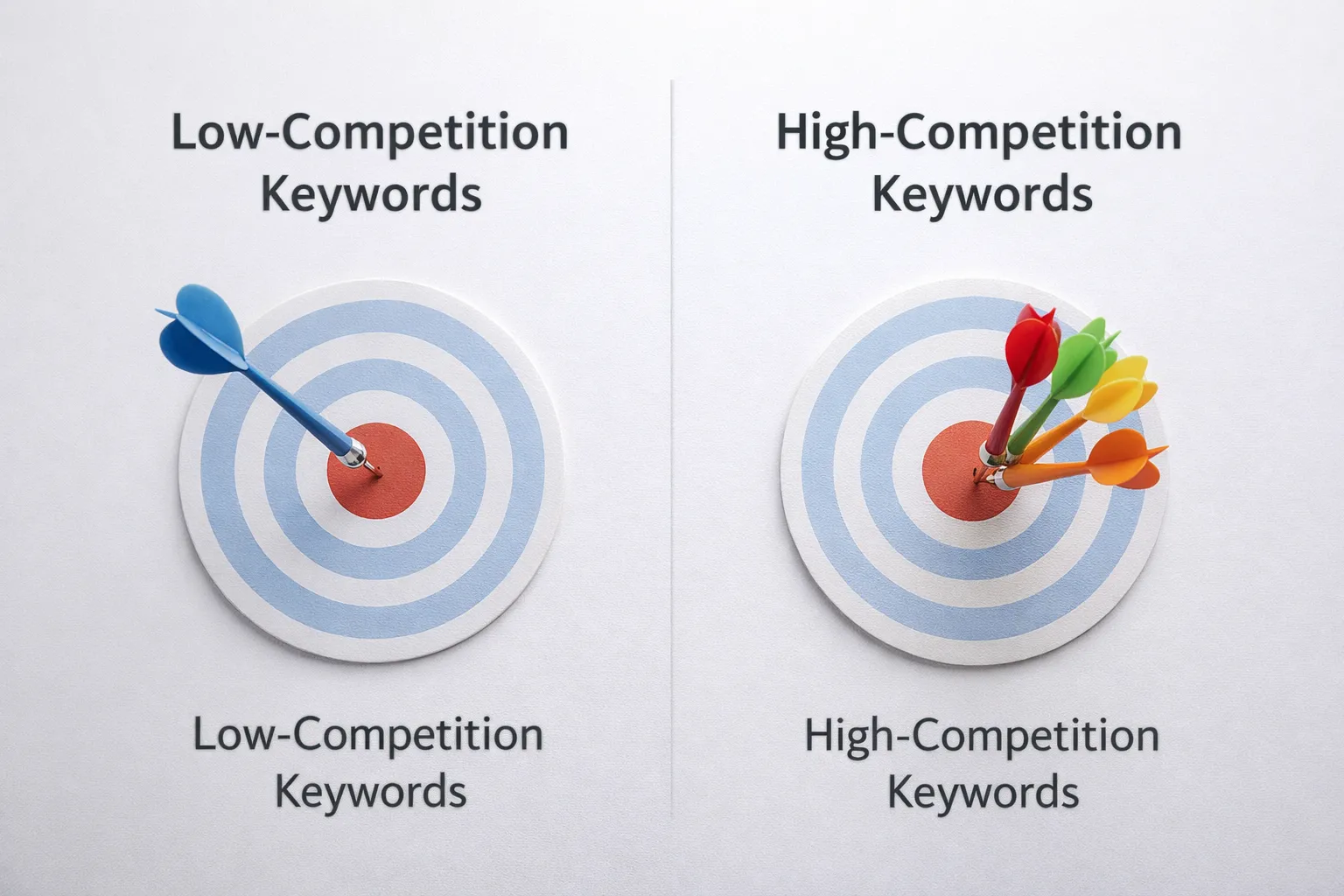
Low competition keywords are search terms with fewer websites competing for rankings, making them easier and faster to rank for. High competition keywords, on the other hand, are dominated by authoritative domains and require significant time, backlinks, and content strength to rank. Choosing between them depends on your website’s authority, goals, and timeline.
Quick Comparison on Low and High Competition Keywords
| Factor | Low-Competition Keywords | High-Competition Keywords |
|---|---|---|
| Difficulty | Low to medium | High |
| Search volume | Moderate | Very high |
| Competition | Limited | Intense |
| Ranking speed | Faster | Slower |
| Conversion potential | High | Moderate |
This example illustrates that low competition, high traffic keywords are ideal for SEO in an AI driven world.
Ways to Discover Keywords with a Low Level of Competition
1. Take Advantage of Tools for Keyword Research that are Driven by Artificial Intelligence
Keyword research that utilizes artificial intelligence can examine search intent and semantic analysis.
Some of these tools are:
- Google Keyword Planner
- Ahrefs
- SEMrush
- Ubersuggest
- AnswerThePublic
These tools help search for keywords that have low competition and potential traffic.
2. Assess Search Intent
When figuring out the low competition keywords for your content, having a good grasp of user intent is important.
Some examples of user intent include:
- Information
- Navigation
- Transactions
- Commercial
Information and long-tail queries often have low competition keywords.
3. Use Long-Tail Keywords
Long-tail keywords have lower competition, as they are longer, more specific phrases.
Examples of long-tail keywords are:
- “best SEO tools for startups”
- “how to optimize content for AI search”
These phrases often qualify as low difficulty keywords with strong intent.
4. Look at “People Also Ask” Sections and Related Searches
Questions from real Google users can provide insight into Google “People also ask” and related searches.
Some of the insights are:
- Niche topics
- Content gaps
- Keywords that have low competition and high traffic potential
5. Examine Content from Competitors
Look at the sites of your competitors to find opportunities to rank.
Process:
- Research main terms your competitors optimize for
- Analyze the gaps in their content
- Research the gaps in content that your competitors have
This practice will help you gain insight into hidden, less competitive opportunities.
Using AI for determining possible low competition keywords
Artificial intelligence can help you analyze larger volumes of data pertaining to keywords.
AI benefits for the content creator
• Helps spot new trends
• Predicts the volume of searches
• Works in the analysis of keywords in the data sets
• Helps in finding keywords that maintain the proper context
The content creator benefits from AI when determining conversational content keywords.
The Search volume and the level of difficulty
It is of utmost importance to content creators to understand the level of difficulty of the keywords in relation to the volume of searches performed.
Keywords characteristics preferred by most content creators
• Less difficulty with an average level in terms of the volume of searches performed
• The intent is evident
• High relevance
These characteristics describe low intent keywords with significant volume in terms of searches performed.
Utilizing Low Intent Keywords to Build Content
1. Building Topic Clusters
When creating content, you should prioritize creating interrelated pieces rather than just optimizing for stand-alone keywords.
Example:
- Main Topic: Digital Marketing
- Search Engine Optimization
- AI Optimization
- Marketing of Content
- Researching Keywords
This method helps in enhancing your authority on the topic.
2. Adhering to Semantic SEO Optimization
The current AI Search engines have the ability to prioritize meaning rather than the exact matches.
- Different but related terms
- Different but related words to yours
- Phrases and terms related to the subject matter
Including the above will boost your relevance and also the chances of ranking higher on the search engines.
3. User Experience
This type of content should be:
- Clear
- Structured
- Actionable
- Comprehensive
AI searches prefer content centered on users.
Finding Low-Competition Keywords: Advanced Tactics
1. Keywords Based on Questions
Competition in these types of keywords is generally lower.
For example:
- “How does AI affect SEO?”
- “What is LLM SEO?”
These types of searches work well with AI search.
2. Emerging Topics
With new technologies and new trends, the competition is typically lower.
For example:
- AI marketing
- Voice search optimization
- Conversational SEO
You will have an advantage if you adopt these earlier.
3. Looking at Search Result Features
Searching for features of a search result will tell you about the competition of keywords.
Some signs of lower competition:
- Fewer authoritative domains
- Less content depth
- Weaker backlink profiles
4. Using Local and Niche Keywords
These keywords more often than not have less competition.
For example:
- “SEO agency in Jaipur for startups”
- “AI marketing tools for small businesses”
This type of keyword will give you targeted traffic.
The most common mistakes when identifying low competition keywords
1. Missing search intent
Nothing will change if there is low difficulty without intent.
2. Targeting irrelevant keywords
It is volume rather than relevance that takes priority.
3. Ignoring the Quality of Content
Every keyword, regardless of competition, requires quality content.
4. Sticking to One Tool
Use a variety of tools for the best analysis.
Success Measurement for Low-Competition Keywords
Important metrics to analyze
- Organic traffic
- Positioning of keywords
- Rate of clicks
- User interaction statistics
- Rate of conversions
Measuring results is instrumental to improving your tactical approach.
Emerging Trends for Keyword Research in AI Search
The evolution of search AI will continue to shape how keyword research is executed.
Emerging trends
- Conversational queries
- Contextual search
- Predictive keyword analysis
- Topic-based optimisation
Targeting low competition keywords will become more significant as AI search develops.
Also Read - Generative AI SEO: How to Rank in AI-Powered Summaries
Conclusion
Understanding and finding low competition keywords is a prerequisite for success in AI-based search environments. Knowing what the low competition keywords are and utilising the right techniques to find them will help marketers achieve rapid growth and rankings.
Searching for low competition keywords with high traffic allows businesses to capture a significant audience without competing with the big players. As AI search develops, strategic keyword research will continue to be important for effective SEO and online visibility.
FAQs About Low Competition Keywords
Q1. Are low-competition keywords always low in search volume?
Ans. No, low-competition keywords are not always low in search volume. Many niche or long-tail keywords have moderate to high traffic but fewer competitors. These low competition keywords with high traffic offer excellent opportunities to rank faster while attracting relevant users with strong search intent.
Q2. How do I identify low difficulty keywords without paid tools?
Ans. You can find low difficulty keywords using free methods like Google autocomplete, People Also Ask, related searches, and competitor analysis. Checking the quality of ranking pages, content depth, and domain authority in search results also helps estimate keyword difficulty without relying on premium SEO tools.
Q3. Why are low-competition keywords important for AI-driven search?
Ans. AI-driven search focuses on context and intent rather than exact keywords. Low-competition keywords often reflect specific user questions and conversational queries, making them highly valuable. Targeting such keywords helps content align with AI search behavior and improves visibility in conversational and semantic search results.
Q4. How many low-competition keywords should I target in one article?
Ans. There is no fixed number, but it’s best to focus on one primary keyword and several related low-competition keywords. This approach improves topical relevance without keyword stuffing. Structuring content around multiple related terms also helps AI systems understand context and enhances overall SEO performance.
Q5. Can low-competition keywords bring long-term traffic growth?
Ans. Yes, low-competition keywords can generate sustainable traffic when combined with high-quality content and topical authority. As your website gains credibility, these keywords help build a strong organic foundation. Over time, ranking for multiple low-competition terms can significantly increase visibility and consistent traffic.
