

A search engine will rank and un-rank your content based on more than simple keywords and backlinks. They are looking for your content’s credibility, expertise and trust. This is why E-E-A-T in AI SEO is particularly important for digital marketers, content creators, and businesses.
Understanding what E-E-A-T is in AI SEO is critical to meeting Google’s standards and users’ expectations with your content. Google demands more and more in evaluating author expertise and ‘real’ experience. It insists on content with ‘real’ experience, for real, in a given topic.
Table of Contents
- E-E-A-T Full Form and Meaning
- What Does E-E-A-T Mean in AI SEO?
- Why E-E-A-T Is Important Inclusion in Today's SEO
- Each Part of E-E-A-T Explained
- E-E-A-T Guidelines: Content Evaluation by Google
- Let's Analyze the Relevance of E-E-A-T with AI Search
- E-E-A-T in Practice For Better AI SEO
- E-E-A-T and YMYL
- How to Optimize Content for E-E-A-T
- Common Myths About E-E-A-T
- The Future of E-E-A-T in AI SEO
- Summary
- FAQs About E-E-A-T in AI SEO
Following E-E-A-T and Google content guidelines helps a website earn long-lasting visibility and trust, as well as sustainable rankings in traditional and AI search.
E-E-A-T Full Form and Meaning
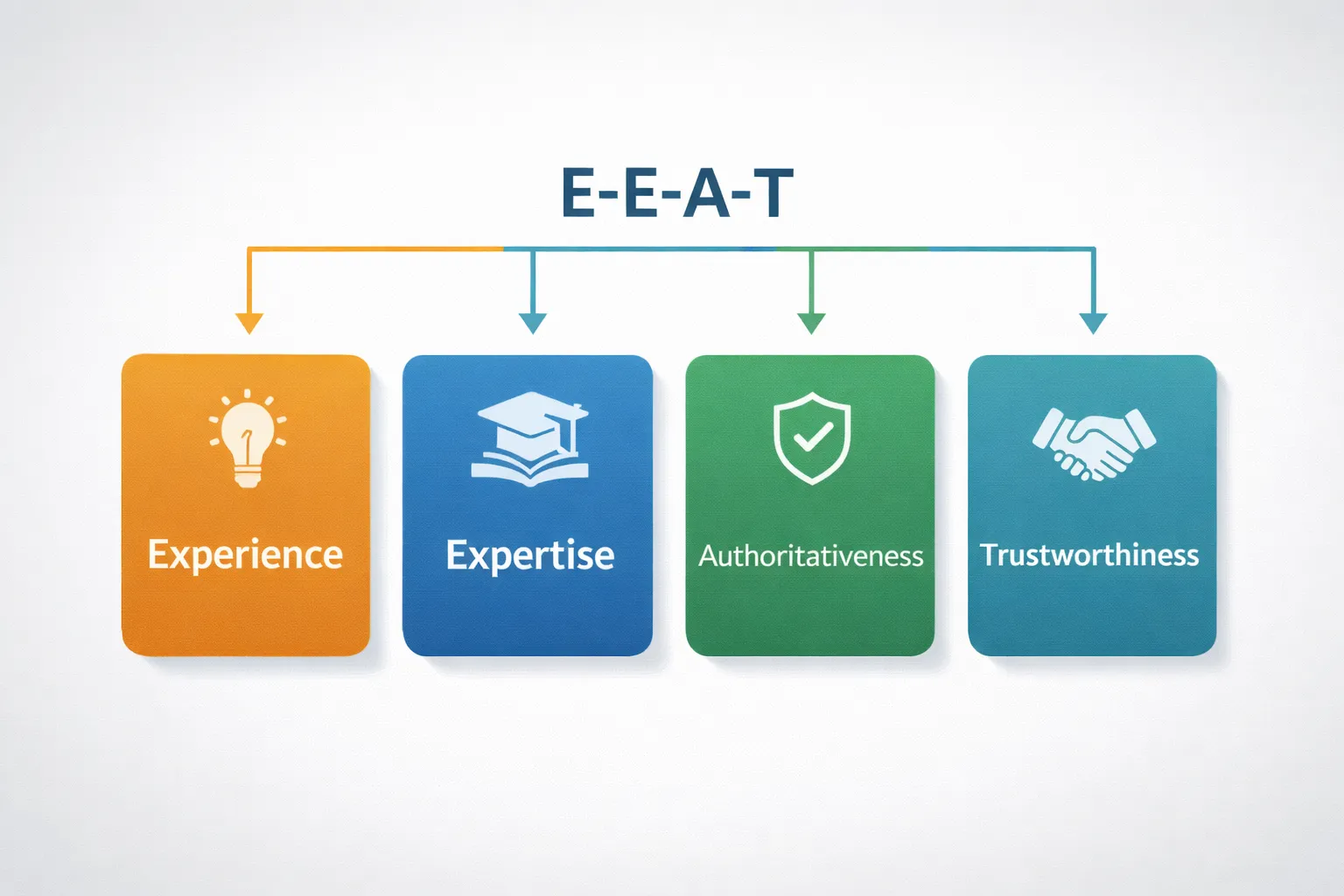
When you search E-E-A-T full form, you get:
- Experience
- Expertise
- Authoritativeness
- Trustworthiness
This is a part of Google’s Search Quality Evaluator Guidelines. These serve to evaluate the credibility of content.
What does E-E-A-T mean in AI SEO?
If we were to break it down simply to understand what is E-E-A-T in AI SEO, it can be put as:
A benchmark framework that assists Google in assessing if content is produced by individuals with the requisite knowledge, credibility, and real-world skills that would enable them to describe the content.
Why E-E-A-T is important inclusion in today's SEO
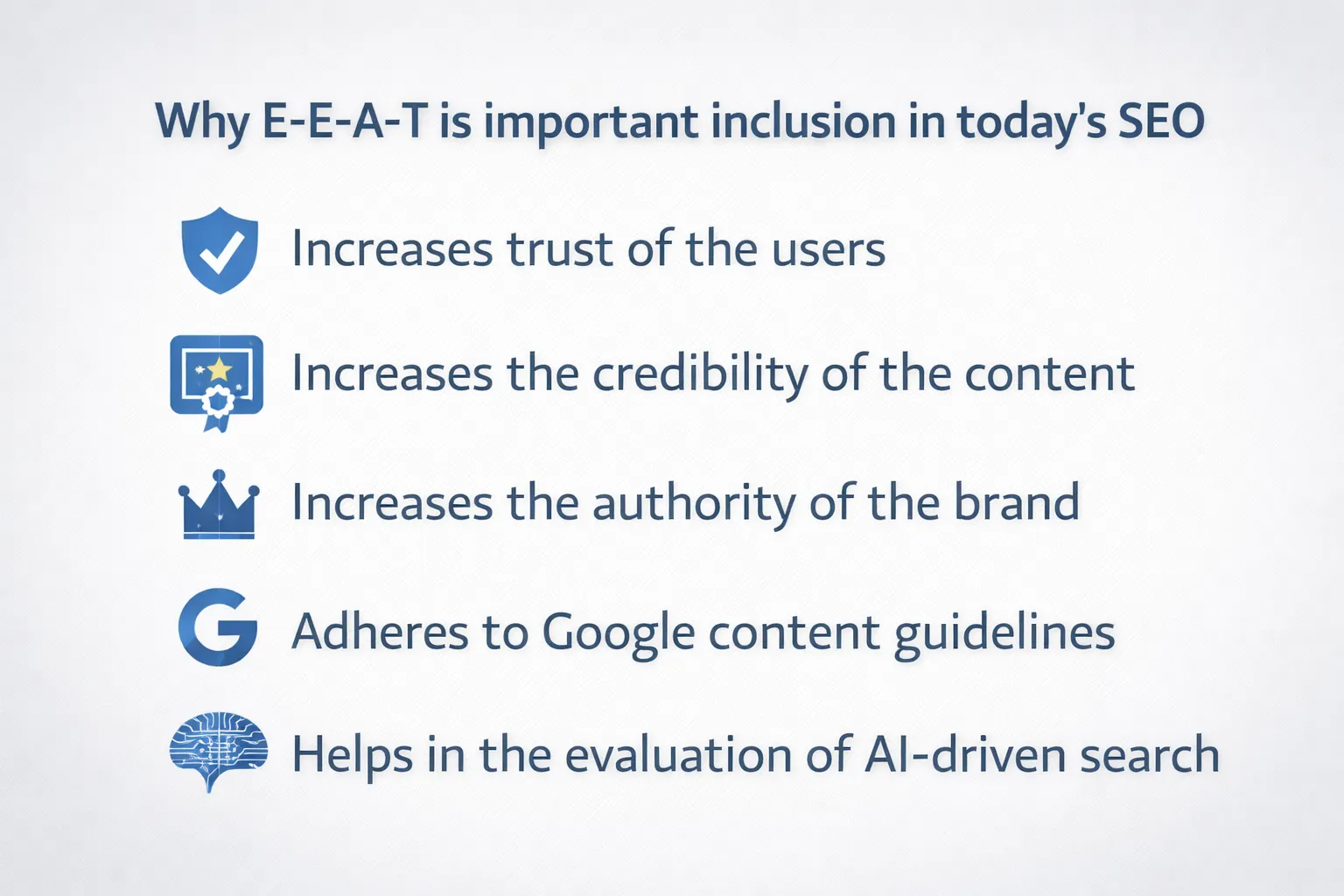
One of the most important missions of Google is to provide the most accurate, helpful and reliable information. E-E-A-T has become crucial for providing rank due to the increased use of AI-based content and the misinformation it can generate.
Some of the most important factors that make E-E-A-T extremely valuable in AI SEO
- Increases trust of the users
- Increases the credibility of the content
- Increases the authority of the brand
- Adheres to Google content guidelines
- Helps in the evaluation of AI-driven search
If a website has a good E-E-A-T score, it will be more likely to rank better and have good visibility in the long run.
Each Part of E-E-A-T Explained
1. Experience
Experience means knowledge that is acquired hands-on. Content is highly regarded by Google if it is produced by someone who has used, tested, or lived the subject matter.
Some examples of experience content include:
- Product reviews by actual users
- Individual case studies
- Personal stories and real-life examples
2. Expertise
Expertise is the level of knowledge and skills a content creator has.
Indicators of expertise:
- Professional qualifications
- Industry knowledge
- Detailed explanations
- Accurate and well-researched information
When discussing issues like health, finance, and law, expertise is critical.
3. Authoritativeness
Authoritativeness is the level of information an author or website has in a specific topic.
Some signs of authority are:
- Good reputation mentions
- Reliable backlinks
- Recognition in an industry
- Good brand presence
4. Trustworthiness
Trustworthiness is the key element of E-E-A-T. Google looks at if people can trust the content.
Some of the trust signals are:
- A website secured by HTTPS
- Trustworthy and clear policies
- Factual content
- Reviews by users that are favourable
E-E-A-T Guidelines: Content Evaluation by Google
E-E-A-T guidelines is used by the evaluators of Google to determine the quality of the content.
Main guidelines to follow
| Factor | What Google Looks For |
|---|---|
| Content quality | Accuracy, depth, relevance |
| Author credibility | Expertise and experience |
| Website reputation | Authority and trust |
| User intent | Relevance to queries |
| Transparency | Clear authorship and sources |
These criteria are similar to Google content guidelines.
Let's Analyze the Relevance of E-E-A-T with AI Search
With the help of AI, the understanding of the text has evolved into a more nuanced understanding, one that takes into account the meaning, context, and reliability.
E-E-A-T and AI Search
- Teaches AI to recognize trustworthy sources
- lmproves understanding on the context of queries
- Reduces the spread of AI misinformation
- Improves the quality of answers on open-ended queries
E-E-A-T is a necessity, not an option.
E-E-A-T in Practice For Better AI SEO
Practical ways to improve E-E-A-T.
Quality of Content
- Originality and Real-life Examples
- Accuracy and Thoroughness
- Timeliness of Updates
Credentials of the Author
Author bios should be inclusive of
- the organisation to which the author is affiliated
- professional background
- links to the author’s social media
Authority of the Website
- Quality backlinks are a must
- Topical authority via content association
- Brand Consistency
Signals of Trust
- Utilise secure protocols and trust
- Publish policies that are easy to understand
- Elicit feedback and reviews
E-E-A-T and YMYL
YMYL refers to the subcategories of content that have a more significant impact on the lives of users, such as financial, legal, medical, and safety content. The application of E-E-A-T to such subjects is stricter.
Instances of YMYL content
- Medical Advice
- Financial Planning
- Legal Guidance
- Investment Information
In these cases, showing competence and reliability is important.
How to Optimize Content for E-E-A-T
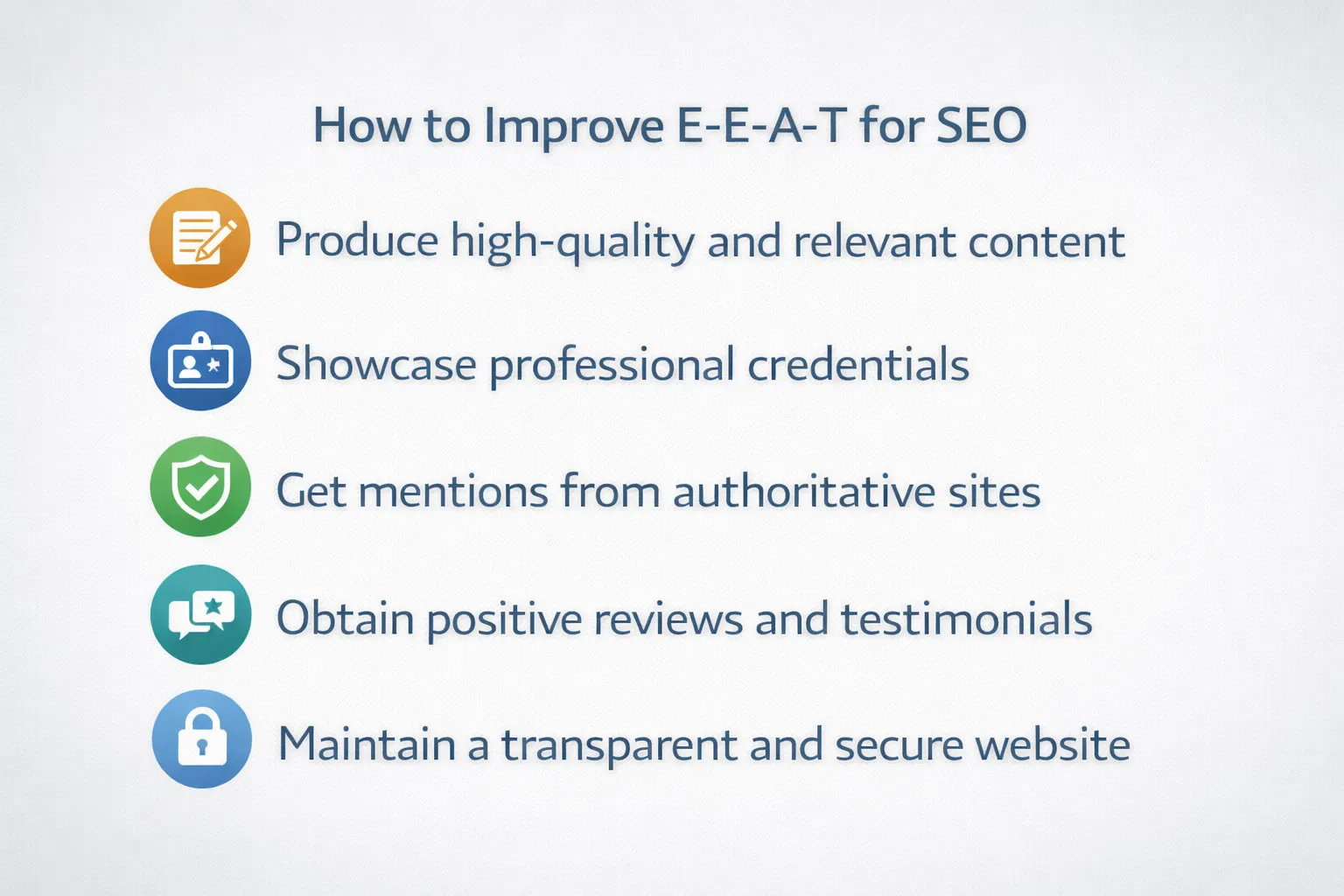
- Create Experience-Driven Content: Use case studies and provide actionable advice to your audience.
- Strengthen Author Profiles: Make credentials, certifications, and industry experience clear.
- Build Topical Authority: Develop related content around the same core topics.
- Improve Transparency: State your references, sources, and when the content does and doesn’t get updated.
- Focus on User Intent: Go beyond surface level questions and provide complete and in-depth answers.
Common Myths About E-E-A-T
• E-E-A-T is a direct ranking factor
- E-E-A-T is not a single algorithmic metric but is in fact part of the way Google looks at the quality of the content.
• Only backlinks matter
- Backlinks are obviously important, but when it comes to E-E-A-T, credibility and trust matter just as much.
• AI-generated content always ranks
- AI-generated content that does not align with E-E-A-T is unlikely to perform well.
The Future of E-E-A-T in AI SEO
Currently E-E-A-T is important, but as AI SEO continues to adapt, it will become even more important.
Evolving Patterns
- More focus on real-world situations
- More scrutiny on author identity
- Merging with AI search applications
- More focus on trust and transparency
When search engines look for E-E-A-T, the website optimizing for E-E-A-T today would be in a better position for the algorithms of tomorrow.
Also Read - 8 Best SEO Practices to Improve Your Rankings in 2026
Summary
Knowing what E-E-A-T means in the context of SEO is crucial for earning and sustaining digital visibility and credibility. The E-E-A-T acronym stands for Experience, Expertise, Authoritativeness, and Trust, and describes the pillars of the content quality score. Businesses can earn content scores from users and search engines by E-E-A-T, meeting Google content guidelines, and using the E-E-A-T guideline checklist.
While AI search tools look for credible and accurate information, E-E-A-T is beyond being just another SEO formula. It is a way of gaining trust and authority for a credible and meaningful digital presence.
FAQs About E-E-A-T in AI SEO
Q1. Is E-E-A-T important for all types of websites?
Ans. Yes, E-E-A-T is important for every website, but it is especially critical for YMYL (Your Money or Your Life) topics like health, finance, and legal content. Even non-YMYL websites benefit from strong E-E-A-T because it improves credibility, user trust, and long-term search visibility.
Q2. How can small websites improve E-E-A-T without big budgets?
Ans.Small websites can improve E-E-A-T by creating high-quality, experience-based content, showcasing author credentials, citing reliable sources, and maintaining transparency. Consistency, originality, and user-focused content matter more than expensive tools, making E-E-A-T achievable even with limited resources.
Q3. Does Google penalize websites with low E-E-A-T?
Ans. Google does not directly penalize websites for low E-E-A-T, but such websites may struggle to rank well. Content lacking credibility, expertise, or trust signals is less likely to perform in search results, especially in competitive or sensitive niches where quality standards are higher.
Q4. Can AI-generated content meet E-E-A-T standards?
Ans.Yes, AI-generated content can meet E-E-A-T standards if it is accurate, well-edited, and enriched with human expertise and real-world insights. Google evaluates content quality, not the method of creation, so combining AI efficiency with human experience is key to maintaining a strong E-E-A-T.
Q5. How long does it take to see SEO results from E-E-A-T improvements?
Ans. Results from E-E-A-T improvements typically appear over several months, depending on competition, content quality, and website authority. Strengthening experience, expertise, authority, and trust gradually build credibility, which leads to sustainable rankings and improved performance in both traditional and AI-driven search.
