

The search experience is changing and fast. Instead of scrolling through endless web results, users are now getting instant, AI-generated answers from platforms like Google AI Overviews, ChatGPT, Gemini, Perplexity, and Copilot.
This is where Generative AI SEO also called Generative Engine Optimization (GEO) steps in. It’s not about ranking #1 on Google anymore. It’s about ensuring AI systems can read, understand, and cite your content in their generative summaries.
In other words, your visibility now depends on how well your content performs inside AI-powered search results, not just traditional SERPs.
Table of Contents
- What Is Generative AI SEO?
- How Generative AI SEO Works
- Why Generative AI SEO Matters Now
- How to Optimize for Generative AI (Best Practices)
- Workflow: From Topic to AI-Friendly SEO
- SEO Generative AI Challenges & Nuances
- Measuring Success in Generative SEO
- AI-Optimized SEO: A Global Guide for Content Creators
- Future of Generative AI SEO
- Key Takeaways
- FAQs on Generative AI SEO Optimization
Generative AI SEO is the new way to make your content visible in AI-powered search results like Google AI Overviews, ChatGPT, and Perplexity.
Unlike traditional SEO, it focuses on being referenced and cited by AI tools rather than ranking #1 on SERPs.
To master SEO for generative AI, create clear, structured, and entity-rich content using schema markup, conversational tone, and authoritative sources.
By learning how to optimize for generative AI, you ensure your brand shows up where users now get answers inside generative AI search results.
What Is Generative AI SEO?
Generative AI SEO is the process of tweaking your content so that large language models (LLMs) and AI technologies used in search engines will recognize your content for generating summaries and/or answers. Essentially, you are focusing on being referenced or used in AI responses instead of trying to get to page 1 of the SERPs.
- Generative AI SEO differs from traditional SEO in that the focus is not on ranking positions, but on being included in AI summaries.
- This involves attention to semantic relevance, trust signals, content structured for specific formats, and content that directly fulfills user intent.
- This is closely connected to Answer Engine Optimization (AEO) or GEO, strategies being utilized by AI-first SEO agencies.
- The latest academic research on generative search AI indicates that such systems favor authoritative well-structured content that demonstrates clarity, and contains references to entities.
How Generative AI SEO Works
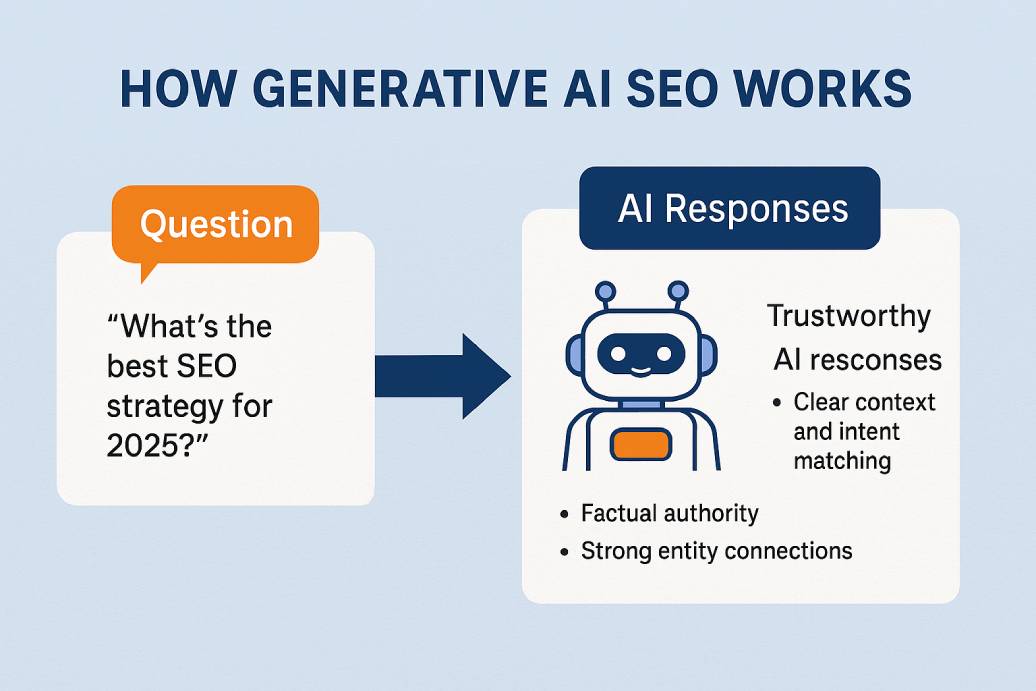
When someone asks a question like “What’s the best SEO strategy for 2026?” tools like ChatGPT or Google’s AI Overview scan their knowledge bases. These include web pages, entity databases, and structured data.
If your content has:
- clear context and intent matching,
- factual authority, and
- strong entity connections, then the AI may use it in its summary.
Your goal is simple: be the source AI systems trust.
Why Generative AI SEO Matters Now
AI-powered search is reshaping how content is discovered and consumed.
1. Shift from Search to Answers
Instead of visiting websites, users get instant summaries. If your content isn’t referenced, you lose visibility even with good rankings.
2. New Metrics of Success
Traditional metrics like CTR and impressions matter less; now it’s about AI citation frequency, generative reach, and AI mentions.
3. Brand Authority in AI Systems
Being cited by AI engines builds brand credibility. Missing from generative AI search results can mean invisibility to tomorrow’s audience.
4. Multilingual and Global Reach
AI tools summarize information across languages — meaning multilingual optimization is the next growth lever for SEO.
5. Evolution of Organic Search
Keywords alone no longer drive performance. Semantic relationships, structured data, and topical authority are the new ranking signals.
In summary, Generative AI SEO is the foundation of global search visibility, it's no longer a futuristic add on.
How to Optimize for Generative AI (Best Practices)
Optimizing for AI-powered SEO means thinking like a machine and a reader. Below are strategies to help your content stand out in generative AI search results.
1. Answer-First Approach
Always start with a clear, concise answer to the user’s question within the first 2 sentences.
AI models prioritize direct, complete responses that can be lifted into summaries.
Example: Instead of starting with background context, lead with the core answer — then elaborate.
2. Build Entity Relationships
AI relies on entity mapping how your topic connects to other topics.
Use related entities, such as tools, experts, places, and products.
Example: “Generative AI SEO combines structured data, semantic search, and AI-powered ranking models like Google’s MUM or OpenAI’s GPT models.”
These relationships help LLMs identify you as part of an entity graph, improving visibility.
3. Structure Your Content for AI Readability
- Clear headings (H2/H3)
- Lists and tables
- FAQs
- Summaries and takeaways
AI models extract structured sections more easily than long blocks of text.
4. Use Schema Markup
Structured data helps AI understand meaning.
Add schema types like:
- FAQPage
- Article
- HowTo
- Organization
This improves your chance of being featured in AI snippets and Google AI Overviews.
5. Cite Authoritative Sources
AI systems favor content that’s trustworthy.
Reference studies, news reports, or expert quotes.
Example: “According to a 2026 Moz study, 68% of AI-generated answers cite content with schema markup and external links.”
This boosts your AI citation likelihood.
6. Optimize for Conversational Queries
People now use AI tools conversationally “What’s the best SEO plugin for WordPress?” or “How to optimize for generative AI?”
Use natural phrasing, question-based headings, and long-tail conversational queries.
This aligns with how users interact with AI.
7. Refresh Content Frequently
AI models value recency.
Regularly update statistics, facts, and references to signal freshness and maintain visibility in AI-powered search results.
8. Add Visual Context
AI Overviews and ChatGPT increasingly integrate visual content.
Use descriptive alt text, captions, and image schema to help your visuals get referenced in generative summaries.
9. Maintain Human Readability
AI loves structure, but humans drive engagement.
Keep your writing conversational, simple, and useful.
AI picks up on engagement signals too; bounce rates, time on page, and social shares indirectly impact inclusion.
Workflow: From Topic to AI-Friendly SEO
| Stage | Action |
|---|---|
| Research | Identify AI-friendly queries (“how to optimize for generative AI”, “AI SEO tools”). |
| Outline | Start with an answer-first format; map subtopics logically. |
| Draft | Use short paragraphs, active tone, and entity-rich phrases. |
| Add Schema | Implement relevant JSON-LD markup. |
| Internal Links | Connect related articles to form topical clusters. |
| Review | Simplify text, check factuality, and cite sources. |
| Publish & Promote | Share on multiple platforms to enhance brand authority. |
| Monitor Mentions | Track citations across ChatGPT, Gemini, and Google AI Overviews. |
SEO Generative AI Challenges & Nuances
The rise of generative AI SEO introduces exciting opportunities, but also a new set of challenges and nuances that content creators and businesses must navigate. Unlike traditional SEO, where ranking factors are visible and measurable, AI-powered SEO operates within opaque algorithms, constantly evolving data patterns, and preference biases. Let’s see this in detail.
- Black-box nature of AI models: Unlike Google’s guidelines, AI models are opaque. It’s harder to reverse-engineer what exactly gets cited.
- Brand bias: More likely used in AI summaries and overviews are larger and more established domains. Smaller sites need to build authority even more aggressively.
- Language & regional complexity: Performance of AI systems is uneven across different regional languages and not all regional content is AI visible.
- Dynamic AI Updates: Because models and algorithms change, there is a need for flexible strategies over time.
- Over-optimization risk: Inflexible structures, extreme schemata, and unnatural phrasing will build in a risk of poor performance. AI should not be optimized at the expense of human readability.
Measuring Success in Generative SEO
When AI is the focus rather than clicks, the optimization metrics change:
- AI Citation Rate: The frequency with which your content is referenced in AI summaries or chat responses.
- Generative Reach / AI Impressions: The number of times your content is surfaced or previewed in AI results.
- Brand Mentions in AI Responses: Direct mentions of your brand or site in AI outputs.
- Referral traffic from AI channels: Visitors coming from AI summaries, chat interfaces, or voice outputs, which are counted as AI-generated content.
- Semantic Visibility Score: The in-house score that shows the performance of your content in relation to central entity and topic graphs and key points.
AI-Optimized SEO: A Global Guide for Content Creators
AI-Optimized SEO helps global content creators gain visibility and engagement across different parts of the world. With the advent of generative AI tools for search, learning how to do SEO for AI tools has become crucial to staying competitive, credible, and discoverable on a global scale.
So what can global creators do to adapt?
- Make multilingual content snippets: Mix English with regionally relevant languages to target different linguistic audiences.
- Localized global context: Mention countries, cities, local happenings, or global companies to make your content relevant to local audiences.
- Scannable, AI-friendly formatting: Use bullet points, Q&A sections, and short, concise sections for AI summarization tools to more readily interact with your content.
- Mobile-first performance: Since mobile devices are the predominant access point most people use, use responsive design and ensure pages are quick to load.
- Structured data and entity markup for AI: Making your content’s meaning, interrelations, and point of authority clear helps AI systems.
- Content freshness: Frequent updates will signal recency to AI and help retain search prominence.
- Off-platform authority: Visibility improves with sharing across global community networks, social media, and online publications.
- AI-Driven analytics tools: Use tools like ChatGPT, Perplexity, and Google AI Overviews to monitor mentions, citations, and brand presence in AI outputs.
In an AI-driven environment, AI-optimized SEO is the new universal language of visibility, intertwining technology, relevance, and global reach.
Future of Generative AI SEO
As AI continues to dominate how users find and consume information, your SEO strategy must evolve.
Key Strategies Ahead:
- Create pillar content that AI tools consistently reference.
- Develop knowledge graphs and entity-based linking for authority.
- Focus on intent-driven and evergreen topics.
- Adapt to blended search (traditional + AI results).
- Leverage AI analytics tools to track visibility and optimize content dynamically.
Key Takeaways
| Aspect | Best Practice |
|---|---|
| Focus | Optimize content for AI summaries, not just rankings. |
| Structure | Use schema, lists, and clear hierarchy. |
| Authority | Cite credible, updated sources. |
| Relevance | Use conversational and entity-rich language. |
| Adaptability | Keep content fresh as AI models evolve. |
Also Read - Guide to AI in Digital Marketing - The Ultimate Guide and Actionable Tips
The future of search is generative. By 2026, AI-powered SEO will define how users discover, trust, and engage with brands online.
If your content isn’t optimized for Generative AI search results, it risks invisibility even with high SERP rankings. Start applying Generative AI SEO best practices today to ensure your brand remains visible, credible, and future-ready.
Get ahead with DO Communication a global SEO and AI optimization agency helping brands thrive in the age of generative search.
FAQs on Generative AI SEO Optimization
Q1. What is Generative AI SEO?
Ans. It’s the process of optimizing your content to be cited or referenced in AI-generated search results, like Google AI Overviews or ChatGPT summaries.
Q2. How is SEO for Generative AI different from traditional SEO?
Ans. Traditional SEO focuses on rankings; Generative AI SEO focuses on inclusion in AI summaries through structured data, clarity, and authority.
Q3. How do I optimize for generative AI?
Ans. Use structured formatting, schema markup, authoritative citations, and conversational tone. Refresh content frequently to maintain visibility.
Q4. What are generative AI search results?
Ans. These are AI-generated summaries or answers that appear above or alongside traditional search results, pulling insights from multiple web sources.
Q5. Is Generative AI SEO the future of search?
Ans. Yes, as AI search systems become the default, optimizing for them will determine your brand’s digital visibility.
