

Improving rankings on SERPs is your major goal for digital marketing. For this, it is essential to conduct a competitive SEO analysis regularly.
Such an analysis helps you to learn where your competitors rank. It also helps to know what keywords they are using to rank high.
Table of Contents
- 1. What is SEO Competitor Analysis?
- 2. How to Identify Competitors in SEOConduct Market Research
- 3. How to Do a Competitive Analysis in SEO
- 3.1 Identify Your Competitors
- 3.2 Identify Important Keywords
- 3.3 Research Your Competitor’s SEO Strategy
- 3.4 Analyze Competing Sites on a Page-by-Page Basis
- 3.5 Top-performing Content
- 3.6 Content Marketing Strategies
- 3.7 SERP Strategy
- 3.8 Evaluate Technical SEO of Competitors
- 3.8 Compare Backlink Profiles and Opportunities
- 3.9 Leverage Paid Search Insights
- 4. SEO Comparison Tool Table
- 5. Why is a Competitive Analysis Important for SEO?
- 6. Types of Competitor Analysis
- 7. What to Include in a Competitive Analysis
- 8. Benefits of Conducting Competitor Analysis
- 9. Bottom Line
- 10. FAQs

What is SEO Competitor Analysis?
SEO competitor analysis is a thorough process of identifying the websites of your competitors that are ranking higher than your website on SERPs. This analysis is crucial to get insights on ways to improve your SEO strategy. An SEO competitor analysis is the same as you might have done for your product development or marketing strategy.
How to identify competitors in SEO

SEO competitor research begins by identifying competitors by looking into other businesses that provide the same services as you, within your target market. There are many ways to identify key players such as through search engines, industry directories, customer feedback, or social media. Once identified, classify them as indirect, direct, or emerging based on their offerings and target audience.
1. Conduct market research
This is an essential area of focus within marketing since it helps identify out there along with analyzing industry reports and trends. Conduct surveys and establish dial in focus groups to determine what they look for when purchasing products and services. These structured methods help build an overview depicting the extent of competition along with conceptualizing how providing certain additional features can create a competitive edge.
2. Seek customer feedback
Customer feedback offers direct insights into your competitors. Ask customers which alternatives they considered before choosing your product or service. This can reveal competing brands, strengths, and weaknesses from a buyer's perspective. Understanding why customers switched or stayed helps refine your offering and uncover competitors that may not appear through traditional research methods.
3. Use the internet
An effective way to find competitors at once is using a search engine. Search for keywords that are related to your industry, products or services, and check which businesses come up at the top. Check business directories as well as forums and review sites. These sources can reveal both major players as well as niche companies which operate within your target market.
4. Check social media
Look for brands targeting your audience on social media platforms. Search through follower lists, hashtags, and mentions of your competitors. Also note their posting patterns regarding user engagement and public perception toward the brand. Such conversations that happen without any formality surrounding the launch of brands are very useful for identifying emerging brands that compete with existing ones.
5. Perform keyword research
Analyzing keywords with tools such as SEMrush, Ahrefs or Google keyword planner may show what companies target the same words with you. Analyze paid search ranks for SEO or PPC investing customers and take note of who competes for traffic among them in organic search too, this method identifies visibility focused competitors and gives insight into their online marketing plan.
How to do a Competitive Analysis in SEO?
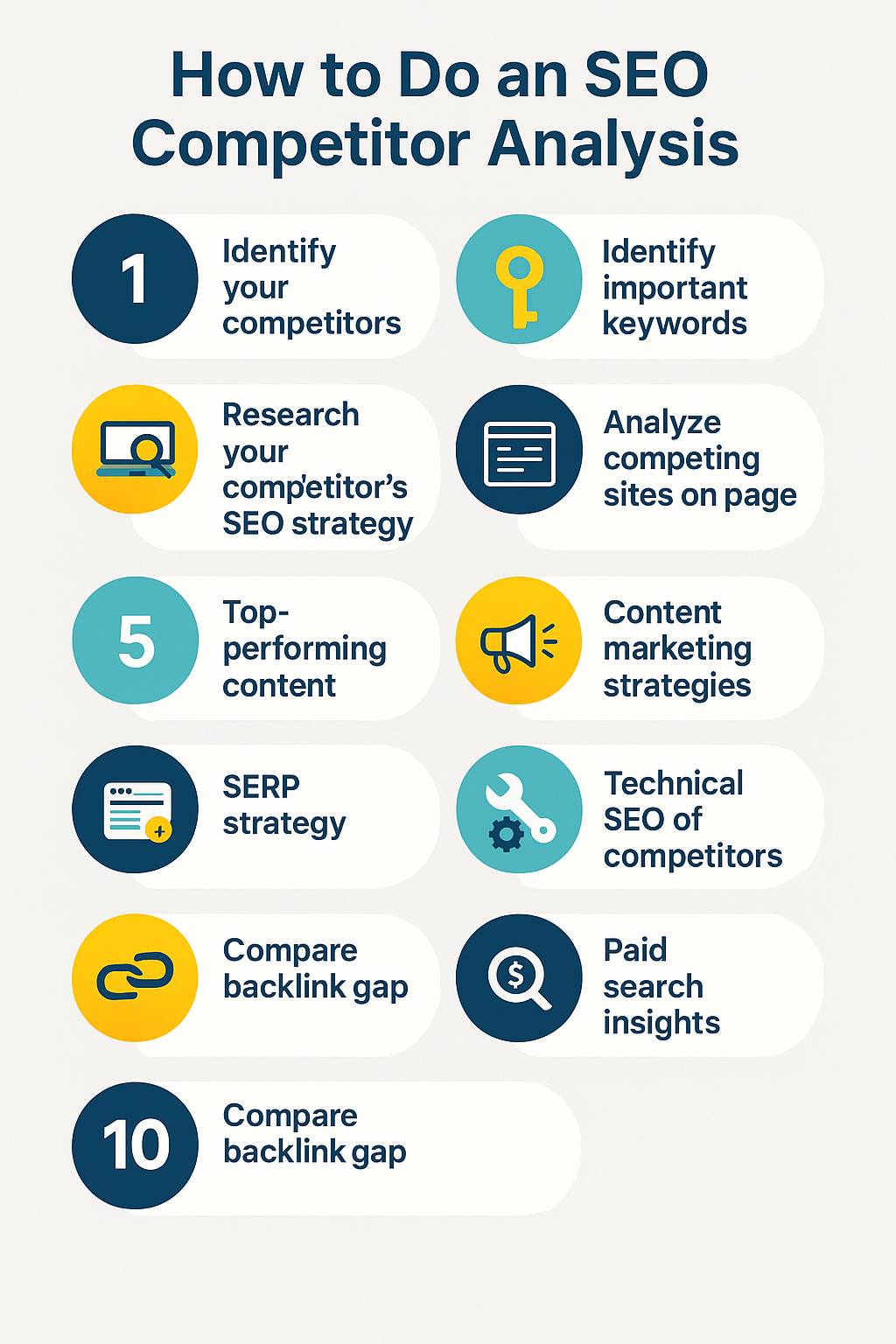
Now the question comes how to do a competitor analysis? It is a thorough process with several steps as explained below.
1. Identify your competitors
Starting on a competitive SEO analysis involves a strategic approach, with the original stride becoming the identification of the competitors. So, how do we identify competitors? Instead of relying on memory, an extensive method involves enumerating indirect and direct competitors.

Strong competitors align closely with your products or services, like organisations in the same sector or niche. For example, if you operate as a kitchen supply retailer specialising in can openers, fellow retailers featuring similar products will be looked at as direct competitors. On the other side, indirect competition might not sell related products but compete for exposure on online search engine results pages (SERPs). These encompass an extensive spectrum, which ranges from informational energy sources to social networking platforms, as well as content hubs or maybe specific bloggers.
After the competitor landscape is delineated, delving into keyword analysis becomes pivotal. By querying high value keywords, you may unravel the SERP dynamics and also recognise the players dominating the rankings. This exploration typically uncovers unexpected contenders overshadowing your online presence.
2. Identify Important Keywords
By this point, you may be able to comprehend the keywords pivotal to steering a constant stream of organic traffic. To unlock the search intent embedded within competitors' content via careful keyword research is a transformative step. It furnishes insights into the rationale behind the targeted queries as well as the particular search intents they endeavour to satisfy. Understanding the reason why competitors gravitate towards certain topics unveils not just the gaps in the content but also illuminates avenues for improving pre-existing written content and seizing upon overlooked angles.

Essentially, scrutinising competitors' keyword techniques does not only unravel keyword opportunities; it fosters a greater understanding of thematic nuances and market dynamics. Equipped with this understanding, you will be able to craft a nuanced content strategy that not merely amplifies the online presence but additionally positions you smartly in the competitive landscape.
3. Research your Competitor’s SEO Strategy
Another important step for SEO competitive analysis is to understand the SEO strategy of your competitors. You must look for the following.
- Their strengths and weaknesses
- Ways to capitalize on their weaknesses
- Ways to follow their strengths
- Where your competitors are outperforming you
- Ways to get rid of your weaknesses
One key point to remember while performing SEO competitor analysis is to never assume anything. You must organise your work and then analyse and compare your strategies with your competitors’. Analyse the following points to understand your competitors’ SEO strategies.
4. Analyze Competing Sites on a Page-by-Page Basis
A granular page-by-page analysis lets you uncover how competitors optimize specific pages for target keywords, rank for user intent, and engage visitors.

This helps identify content gaps, UX strategies, and SEO opportunities that domain-level audits miss.
What to Analyze:
- Priority Ranking Pages:
Use tools like SEMrush or Ahrefs to find which individual pages drive the most organic traffic to your competitors. Focus on landing pages, blog posts, service/product pages, and comparison articles.
- On-Page SEO Elements:
Evaluate:
(i). Title Tags: Are they keyword-rich and compelling?
(ii). Meta Descriptions: Are they clear, with a strong CTA?
(iii). Headers (H1–H3): Do they use relevant keyword variations?
(iv). Keyword Placement: Density, LSI (semantic relevance), and placement in key areas like intros and headings.
- Content Quality & Structure:
Break down:
(i). Word count and depth of content
(ii). Use of visuals (images, infographics, videos)
(iii). Internal and external links
(iv). Presence of rich elements (FAQs, bulleted lists, schema)
- UX and Engagement Features:
Assess:
(i). CTAs: Placement, frequency, and clarity
(ii). Trust Signals: Reviews, awards, testimonials
(iii). Layout: Is it scannable, mobile-friendly, and fast-loading?
- Conversion Triggers:
Check if pages use:
(i). Lead gen forms
(ii). Pop-ups or chat widgets
(iii). Interactive tools (calculators, assessments)
(iv). Email capture mechanisms
- Performance Metrics:
Use tools like SimilarWeb, Ubersuggest, or PageSpeed Insights to understand:
(i). Bounce rate (if available)
(ii). Estimated traffic
(iii). Mobile usability
(iv). Page speed insights
5. Top-performing content
The first step is to look for the top-performing content of your competitors. For this, use Google and trusted keyword research platforms. This will help you identify the pages and articles that are majorly contributing to the high ranking of your competitor’s website. Now, compare this content with yours and see how they match up. It will provide you with a deep understanding of which queries of your audience you must target and which are irrelevant.
6. Content Marketing Strategies
Another crucial step is to identify the marketing strategies used by your competitors. Start noticing crucial factors of their content and distribution strategies. This way, you will be able to identify the type of content they are focusing on, like long-form blogs, glossaries, or short articles. Additionally, you must also keep track of the content format your competitors are using. Is it mostly written content, or are they also focusing on infographics and videos? They will most probably use different content forms to rank high on SERPs. Now, pay attention to the quantity of content your competitors are posting regularly. You must also make a note of the content length and quality. These factors will significantly help you determine how your content can rank better. This is because such analysis will help you make your content more meaningful, understandable, and high-quality. Such quality content gets easily recognized by Google, and it will rank your website higher on SERPs.
7. SERP Strategy
Are they using FAQs schema in their articles? Do they appear in featured snippets? Do you see them in image carousels? Knowing about their exact position will allow you to adapt to the strategy that is working the best for them.
Use all the information you get from the above data to enhance your content and soon you will be seeing your website ranking higher than your competitors. However, these are not the only steps to follow for competitor analysis. Experts use several other ways for a thorough analysis.
Also Read: How SEO Impacts Your Business: Unveiling the Power of Online Visibility
8. Evaluate Technical SEO of Competitors
A strong technical foundation is key to search engine performance. When analyzing your competitors, assess how well their websites perform technically.

This can uncover opportunities to improve your site’s usability and crawlability.
Key Technical Elements to Compare:
- Page Speed: Use PageSpeed Insights or GTmetrix to compare loading times. Faster sites improve user experience and are favored by Google.
- Mobile-Friendliness: Use Google’s Mobile-Friendly Test to ensure your competitors are optimized for smartphones and tablets.
- Core Web Vitals: Metrics like Largest Contentful Paint (LCP), First Input Delay (FID), and Cumulative Layout Shift (CLS) are now ranking signals.
- Crawlability: Tools like Screaming Frog can uncover broken links, duplicate content, or missing meta tags.
- Schema Markup: Use Google’s Rich Results Test to check if your competitors are using structured data to appear in rich snippets.
9. Compare Backlink Profiles and Opportunities
Backlinks remain one of the top-ranking signals in SEO. Analyzing your competitors’ backlink strategies helps you find high-quality domains and link-building opportunities.

What to Analyze:
- Referring Domains: Use Ahrefs or SEMrush to discover how many unique domains are linking to your competitors.
- Anchor Texts: See what anchor text is commonly used to link to your competitor’s site.
- Top Linking Pages: Identify which content on their site is earning the most backlinks.
- Linking Domain Authority: Focus on quality over quantity—target backlinks from reputable, high-authority websites.
- Backlink Gap: Use SEMrush’s or Ahrefs’ Backlink Gap Tool to identify domains linking to your competitors but not to you.
10. Leverage Paid Search Insights
While SEO focuses on organic rankings, understanding your competitors’ paid strategies gives you a 360° view of their digital marketing efforts.
What to Explore:
- Competitor Ad Copy: Use tools like SpyFu or SEMrush to analyze what headlines, calls-to-action, and offers your competitors are using in paid search ads.
- Paid Keywords: See which high-intent keywords your competitors are bidding on—these often indicate profitable areas of focus.
- Landing Pages: Evaluate the structure, content, and CTAs of their PPC landing pages. They’re often well-optimized and conversion-focused.
SEO Comparison Tool Table
|
|
|
|
|
|
|
|
|
|
|
|
|
|
|
|
|
|
|
|
|
|
|
|
|
|
|
|
|
|
Also Know: Best SEO Tools For 2025
Why is a Competitive Analysis Important for SEO?
The importance of SEO competitive analysis is simple. You need it to keep track of where your competitors are spending their time and resources to rank higher on SERPs than you. This analysis will also help you understand how they respond to industry trends. Such an analysis is your tool to uncover your SEO strategy’s strengths and weaknesses by comparing it to your competitors’ strategies. The results of this analysis help you target high-impact keywords.
Types of Competitor Analysis
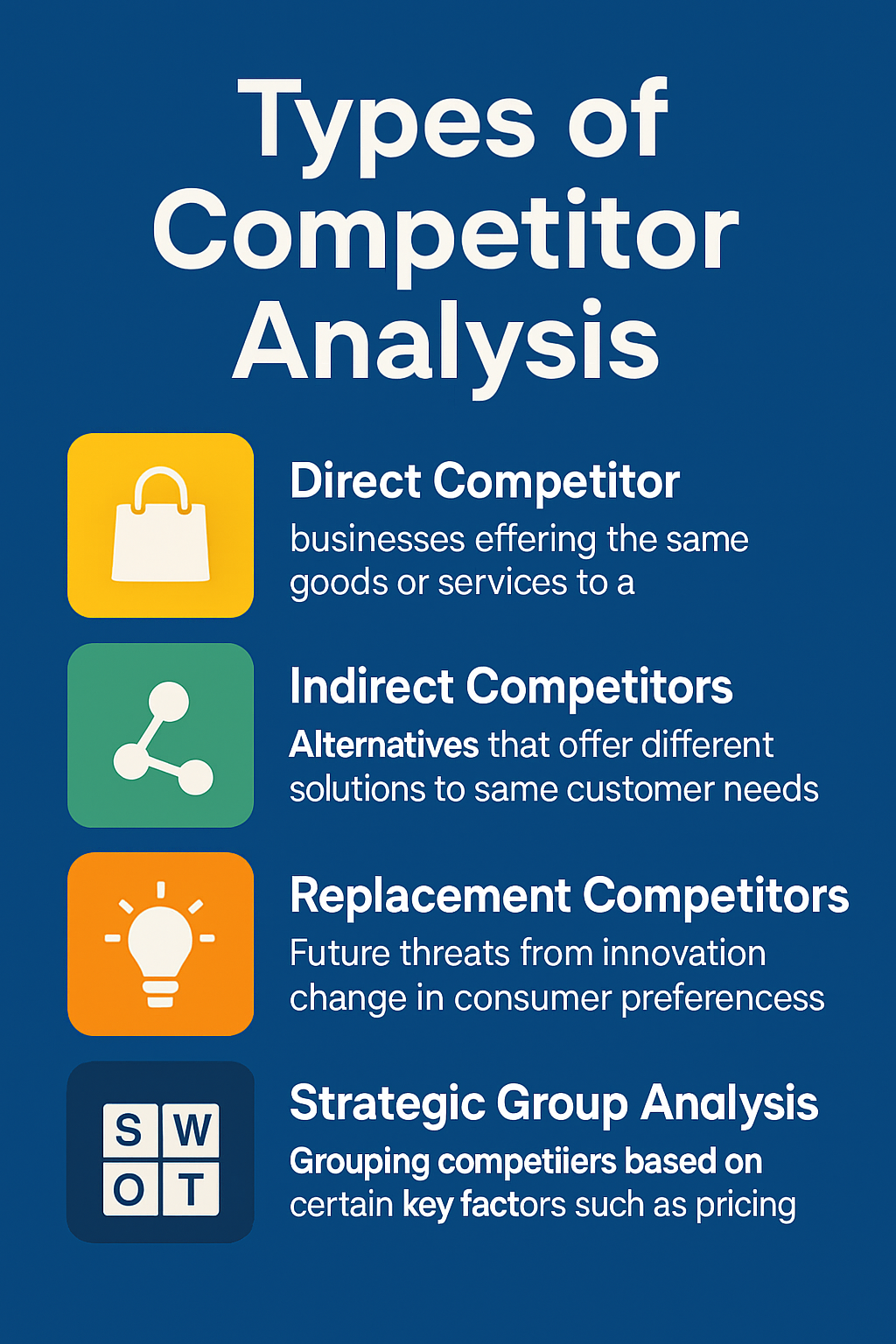
Based on the area of business and the evolution of the market, a competitor analysis can have several distinct types.
- Direct competitor analysis focuses on businesses offering the same goods or services to a particular market segment.
- Indirect competitor analysis shifts attention to look for alternatives that offer different solutions to the same customer needs.
- Replacement competitors are better known as future threats from innovation, change in consumer preferences, or overhaul within a brand.
- Strategic group analysis centers around grouping competitors based upon certain key factors such as pricing and distribution strategies.
Their strengths and weaknesses along with other internal or external factors are summarized through something called SWOT analysis. All types perform filters in their own unique ways thus allowing for thorough decision-making based on rich strategic data.
What to Include in a Competitive Analysis
The SEO competitive analysis is complete by focusing on some key elements first. Begin by outlining the direct and indirect competitors, as well as compiling their product or service portfolios. Scrutinize how they set prices, advertise and market, and position themselves within the industry. Review their strengths and weaknesses, along with their customer demographics and the distribution systems used to reach them. Consider the various aspects of their digital face, like how well do they use websites, social media platforms, and SEO? Don’t forget to look at the ratings that have been accorded to them together with the reputation details in order to measure distress versus eustress. Identifying USPs enables clearer focus on your own differentiation strategies. As an example, observing newly formed partnerships or changes within a given market such as product introductions aids in understanding what influenced certain moves so that planning can be done accordingly.
Benefits of conducting competitor analysis
Competitor analysis can offer helpful insights to guide businesses to make smart strategic choices. Since every business has diverse strengths and weaknesses, their market presence, pricing strategies along with customer relations policies help in determining a company’s areas of improvement as well as differentiation. Using proactive response mechanisms assist companies in staying ahead of shifts due to innovation, market change, and consumer attitude trends.
Moreover, gaps highlighted during the analysis point out critical areas in which brands can improve on their unique selling proposition (USP) making marketing more focused, streamlined and efficient while optimizing the services or products offered. The overall outcome is prudent spending of business resources and reduced risk along with increased ability to stay ahead amidst competition through continuous learning from other companies’ victories and failures.
Also Read: Why SEO Matters for Your Business & Boosts Success
Bottom Line
Reading this post must have helped you understand how to do a competitor analysis and why it is important. It is a critical step to enhance your ranking on SERPs and organic traffic. However, such an analysis is a thorough procedure that requires time and expertise. Partnering with DO Communication, the best SEO company in Gurgaon, can boost your visibility where it matters most. So, contact us today to help you with this.
FAQs: Common Questions Competitor Analysis in SEO
Q1. What tools can be used for competitor analysis?
A. Several tools can help with competitor analysis, including SEMrush, Ahrefs, SimilarWeb, SpyFu, and Google Alerts. These tools provide insights into website traffic, SEO performance, keyword rankings, backlink profiles, and content strategies. Social media analytics tools like Sprout Social and Hootsuite also help monitor competitor engagement and trends across platforms, making your analysis more data-driven and comprehensive.
Q2. How often should you perform competitor analysis?
A. Competitor analysis should be conducted at least quarterly to stay updated with market shifts, new entrants, and changes in competitor strategies. However, in fast-moving industries like tech or e-commerce, monthly reviews may be necessary. Regular analysis helps you stay agile, refine marketing tactics, and adapt to emerging trends before they impact your market position.
Q3. How can competitor analysis help with SEO?
A. Competitor analysis enhances SEO by revealing the keywords competitors rank for, their backlink sources, and top-performing content. It helps identify keyword gaps, optimize your own strategy, and uncover link-building opportunities. By understanding what’s working for others in your niche, you can improve your visibility, target more relevant traffic, and outperform competitors in search rankings.
Q4. Can competitor analysis be done without paid tools?
A. Yes, competitor analysis can be conducted using free resources like Google Search, Google Trends, Google Alerts, and social media platforms. You can manually review competitor websites, analyze their content, track user engagement, and monitor reviews. While paid tools offer deeper insights, free methods still provide valuable data for small businesses or startups with limited budgets.
Q5. What are the potential risks of not conducting competitor analysis?
A. Skipping competitor analysis can lead to strategic blind spots. You may miss market shifts, pricing changes, or new offerings that impact your customer base. Without this insight, your brand risks falling behind, losing relevance, and missing growth opportunities. Competitor analysis helps you stay competitive, innovate proactively, and make informed business decisions that drive long-term success.
