

Search is no longer about blue links alone, it’s about answers, context, and intent resolution.
Thanks to ChatGPT and other AI-enabled technologies, the world of digital searching is entering a new phase. This has led to potential shifts in how consumers approach their search activities, and how commercial search engines like Google, which has had a dominant market position, are perceived now. Recent clickstream and performance studies highlight fascinating insights into how ChatGPT Search (also known as SearchGPT) is being used, how fast it is growing, and whether it is beginning to influence user search behaviour on a larger scale.
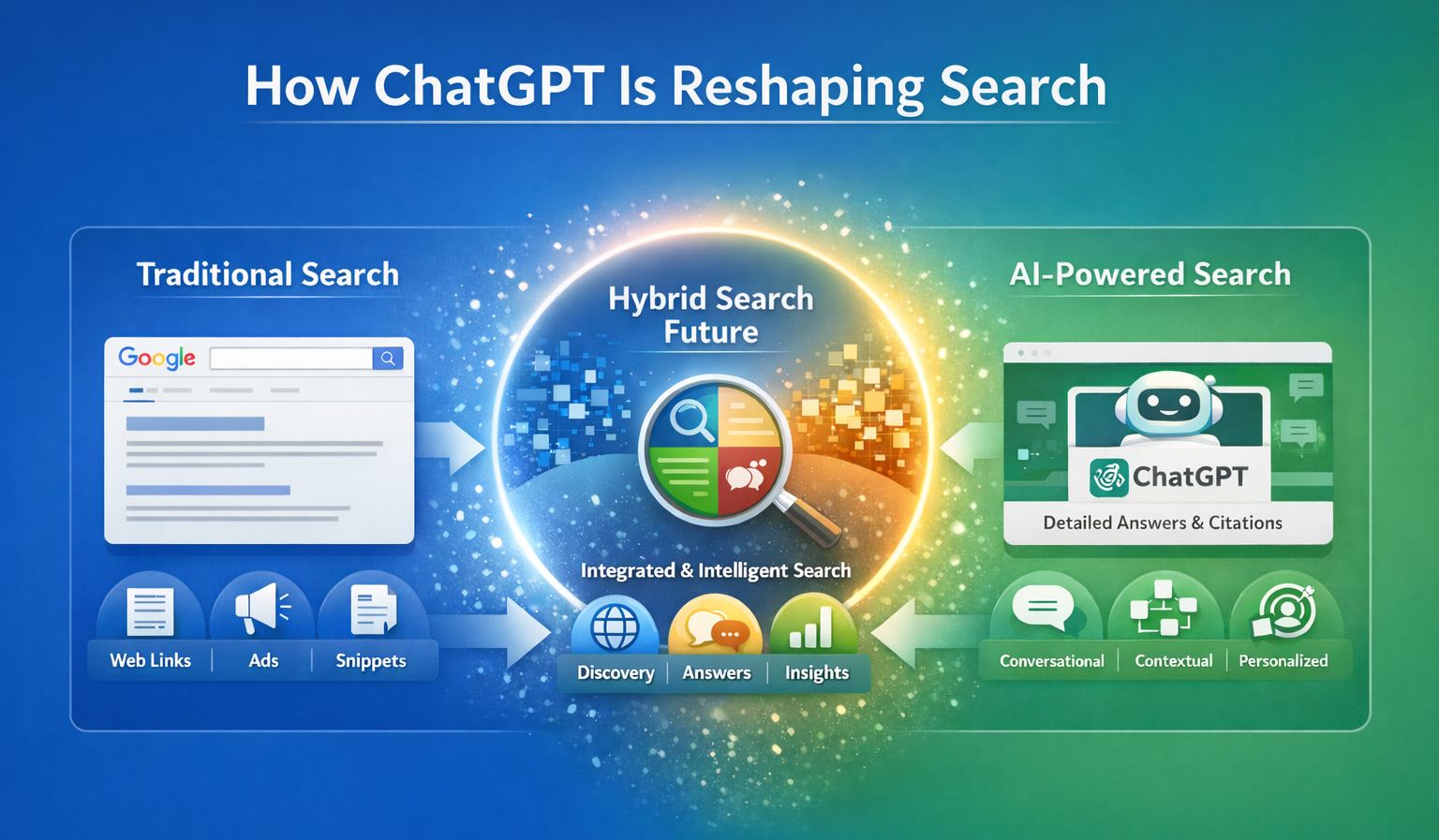
This research suggests that ChatGPT is a value-added technology that is gaining significant market traction in its own right and is affecting the flow of new traffic to online shopping, news, and educational resources.
The purpose of this blog is to synthesise these data trends in search of a focused summary that illustrates the evolved function of ChatGPT in contemporary search.
In This Guide
1. ChatGPT’s Rapid Growth vs Google’s Search Dominance
- ChatGPT Adoption Trends (Global & India)
- Google vs ChatGPT: Search Scale Comparison
2. Why Users Trust ChatGPT for High-Intent Queries
- Most Common High-Intent Use Cases
- User Satisfaction & Trust Comparison
3. Does ChatGPT Reduce Website Traffic? The Reality of Outbound Clicks
- Industries Receiving Traffic from ChatGPT
- Why ChatGPT Still Sends High-Quality Visitors
4. ChatGPT Answers vs Google Search Snippets
- How Conversational AI Improves Answer Quality
- UX Differences: Snippets vs Contextual Responses
5. The Shift Toward Conversation-First Search Experiences
- What Modern Users Expect from Search
- Time-to-Answer: Google vs ChatGPT
6. The Future of Search: Why Hybrid Search Will Win
- AI Search + Traditional Search Working Together
7. Final Thoughts: What This Means for SEO, Brands & Marketers
There are certain interesting points that we can go through in this write-up.
1. ChatGPT is growing fast, but is it replacing Google
The ChatGPT search adoption has rapidly experienced a major shift. Based on Datos data, ChatGPT's U.S. user base went from 6.95% to 14.68% in the span of a year, from 2024 to 2025, showcasing the skyrocketing interest surrounding AI search. Users have also shown increased engagement, with a 195% increase in ChatGPT sessions on a per-user basis. Users are increasingly utilising ChatGPT for summary, conversational, and interpretative queries.
Talking about the Indian market, one of the fastest-growing markets for AI platforms like ChatGPT, recent reports have shown that India now accounts for 13.5% of global ChatGPT monthly active users, surpassing the United States, indicating very high adoption of AI tools among Indian internet users.
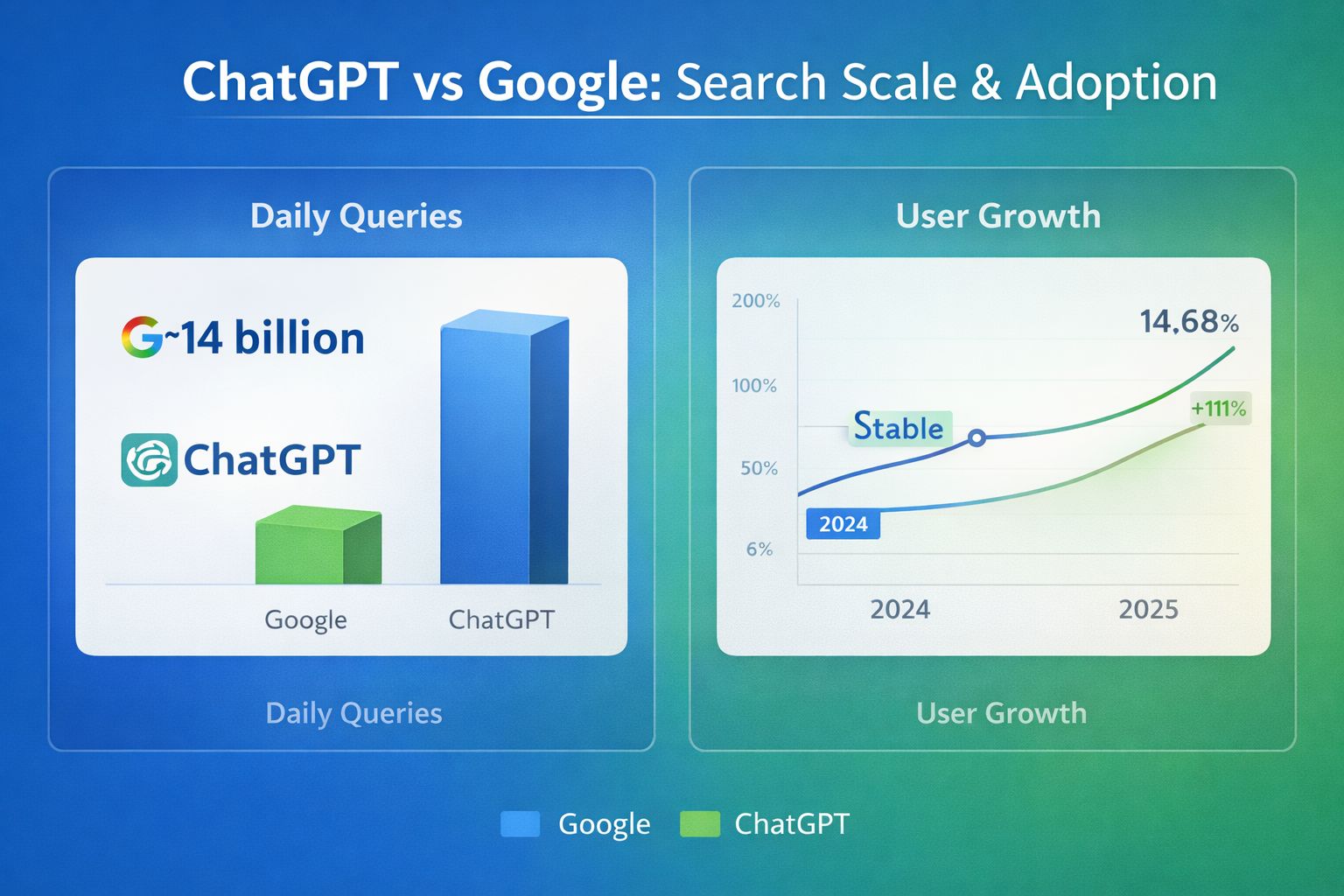
However, despite this growth, ChatGPT is not close to dominating the search engine market. Currently, Google hosts 14 billion searches every day. ChatGPT, on the other hand, only hosts 37.5 million searches daily, or 0.25% of the search engine market. When factoring in the entirety of the AI search engine ecosystem, the search engine market still greatly outweighs it.
Usage Comparison: Google vs. ChatGPT
|
Metric |
Google Search |
ChatGPT (SearchGPT) |
|
Daily Queries |
~14 billion |
~37.5 million |
|
Global Search Market Share |
~92–93% |
~0.25% |
|
Users (2024–2025 Growth) |
Stable |
6.95% → 14.68% |
|
Sessions per User Growth |
Slight |
+195% |
Key Insight
ChatGPT is not replacing Google. It is complementing search, particularly for complex, high-intent, and interpretative queries.
Verdict: Google remains dominant for discovery and navigation, while ChatGPT is rapidly becoming the preferred interface for reasoning, synthesis, and decision-making.
2. Users Trust ChatGPT For High-Intent Queries/Questions
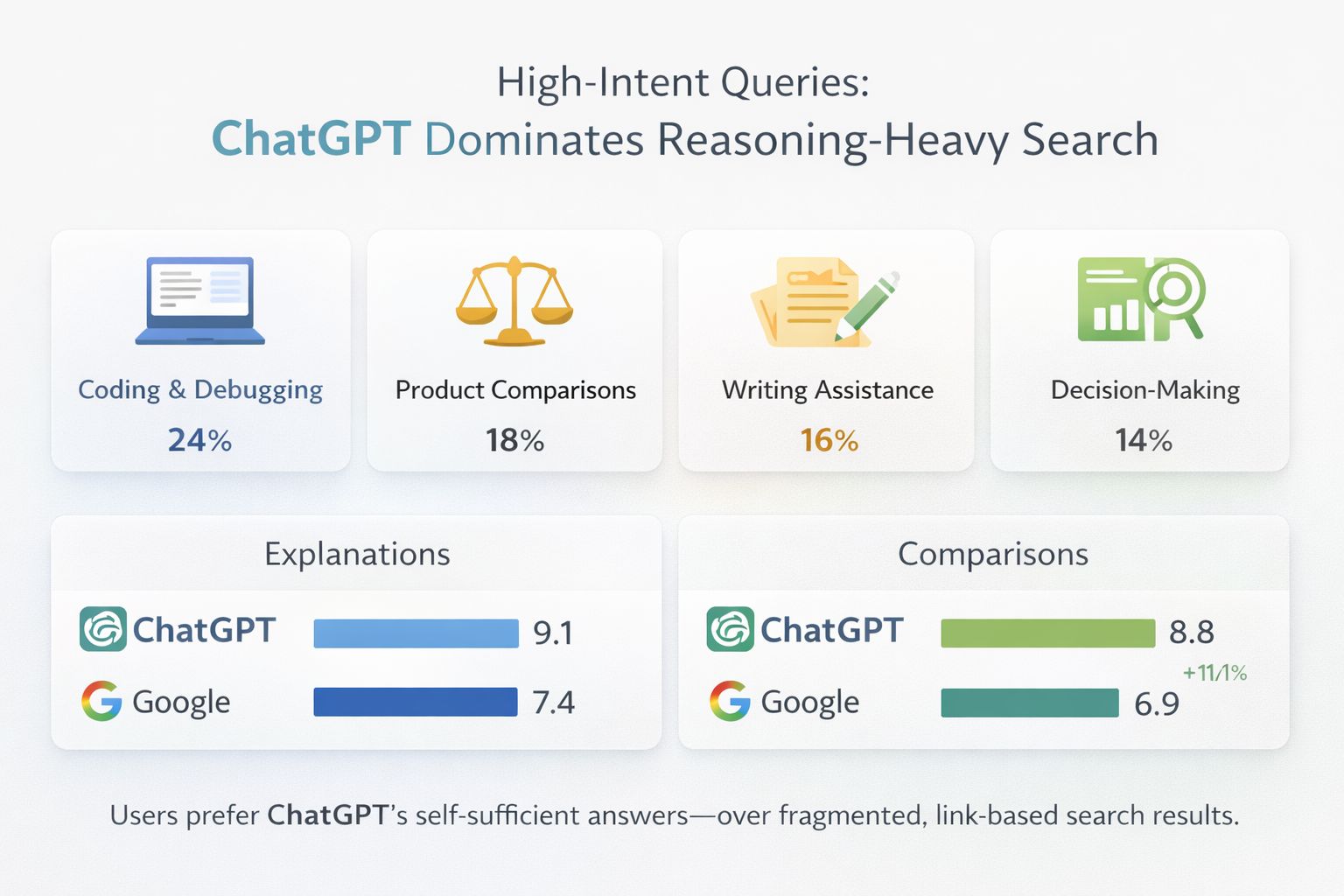
Notably, users trust ChatGPT with high-intent questions more than Google. These questions involve summarisation, comparisons, coding, product evaluations, and explanations and not simple fact-finding missions. ChatGPT does not simply provide users with web pages to extract disparate information. Rather, it provides them with a synthesis of information integrated into a single, concise concept, which is much more convenient and time-saving.
Most Common High-Intent Use Cases
|
Query Type |
Estimated Share of Usage |
Example Tasks |
|
Summaries & explanations |
28% |
“Explain inflation in simple terms” |
|
Coding help |
24% |
“Fix Python error in my script” |
|
Product research & comparisons |
18% |
“Best laptop under ₹70,000; compare models” |
|
Writing help |
16% |
“Draft a cover letter” |
|
Decision support |
14% |
“Which CRM suits my small business?” |
Why Trust Is Higher
The trust users have in ChatGPT is reflected by the high level of self-sufficient queries. Rather than providing web pages to sift through 10 links, users prefer ChatGPT context-embedded answers for a sequence of tasks. This can be seen in the table below.
|
Platform |
Avg. Satisfaction (1–10) |
|
ChatGPT for explanations |
9.1 |
|
Google for explanations |
7.4 |
|
ChatGPT for comparisons |
8.8 |
|
Google for comparisons |
6.9 |
Verdict: Thus, ChatGPT is especially excelling at high-intent user tasks that search engines typically underperform in attaining. The greater the task complexity/results to be attained, users would continue to gravitate to ChatGPT. There seems to be high levels of structural change occurring in how users seek to obtain knowledge. It seems as if Google is getting to be less preferred and ChatGPT is getting to be more preferred.
A more positive response is to be attained to complete more complex search tasks with ChatGPT.
3. ChatGPT Drives Real Traffic To External Websites
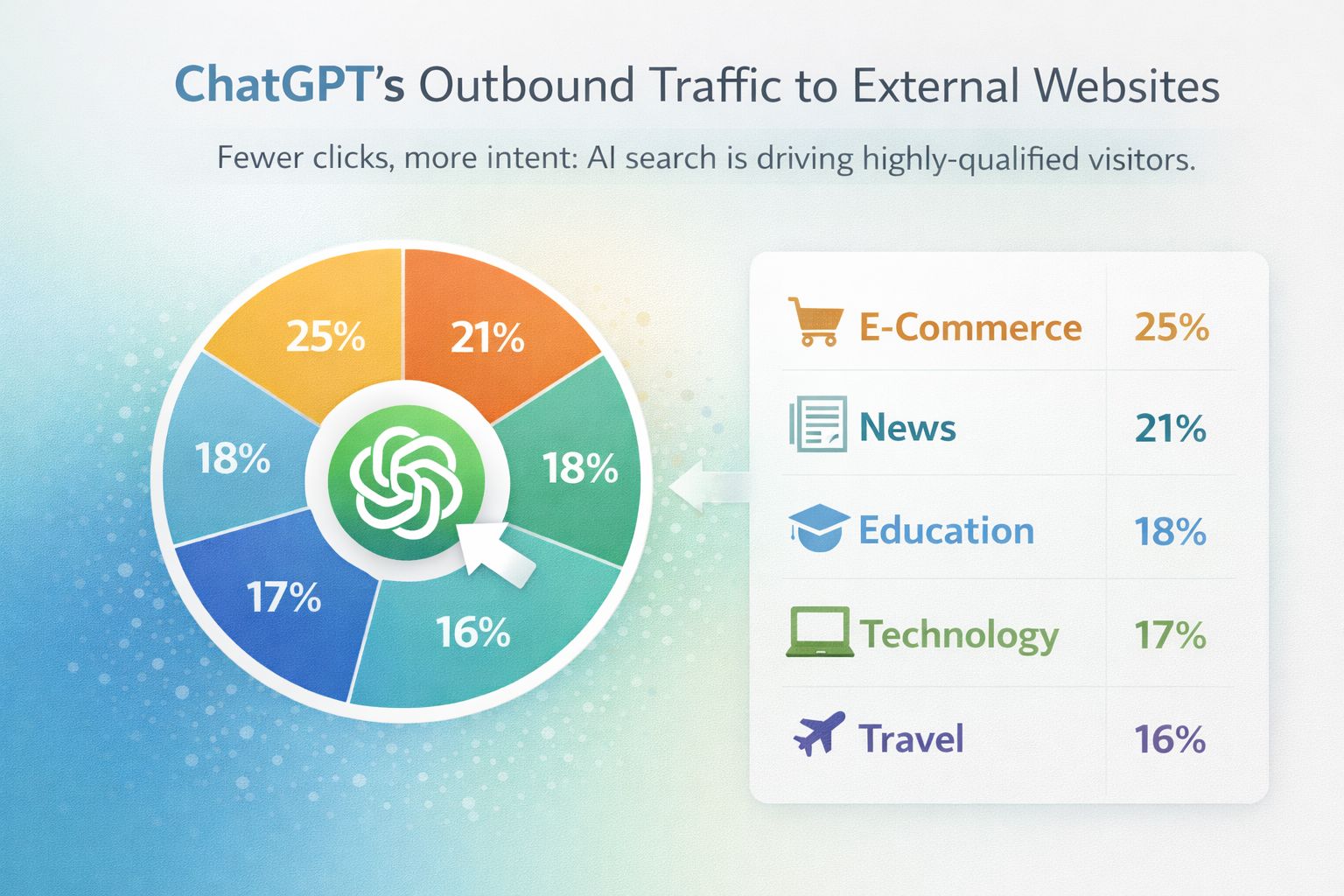
The fear that AI tools would eliminate clicks (“zero-click search”) doesn’t fully hold here. The ChatGPT search tool continues to direct users to external sites, particularly when they are seeking information, citations, news, or purchasing options.
Categories Receiving the Most ChatGPT-Driven Traffic
|
Website Category |
% of ChatGPT-Driven Clicks |
|
E-commerce |
32% |
|
News & media |
27% |
|
Education & research |
22% |
|
Tech & developer resources |
11% |
|
Travel & local services |
8% |
Why Users Click Out
Users hyperlink to ChatGPT to narrow the field of options, and then click to access the sites. For users who need:
- Verified data (prices, specs)
- Human opinions (reviews)
- In-depth reporting (news)
- Official sources (docs, regulatory websites)
Verdict: ChatGPT is not detrimental to the traffic of other websites. Instead, it changes the traffic each website receives by streamlining the process and serving as a point of qualification to access their site. Instead of many low-quality clicks, websites are receiving a few high-quality clicks, which is more advantageous to the sites, as well as to publishers and e-commerce sites.
4. ChatGPT Answers Often Outperform Traditional Search Snippets
Unlike traditional search snippets, ChatGPT answers provide clearer, more contextual, and tailored answers and so outperform them more often.
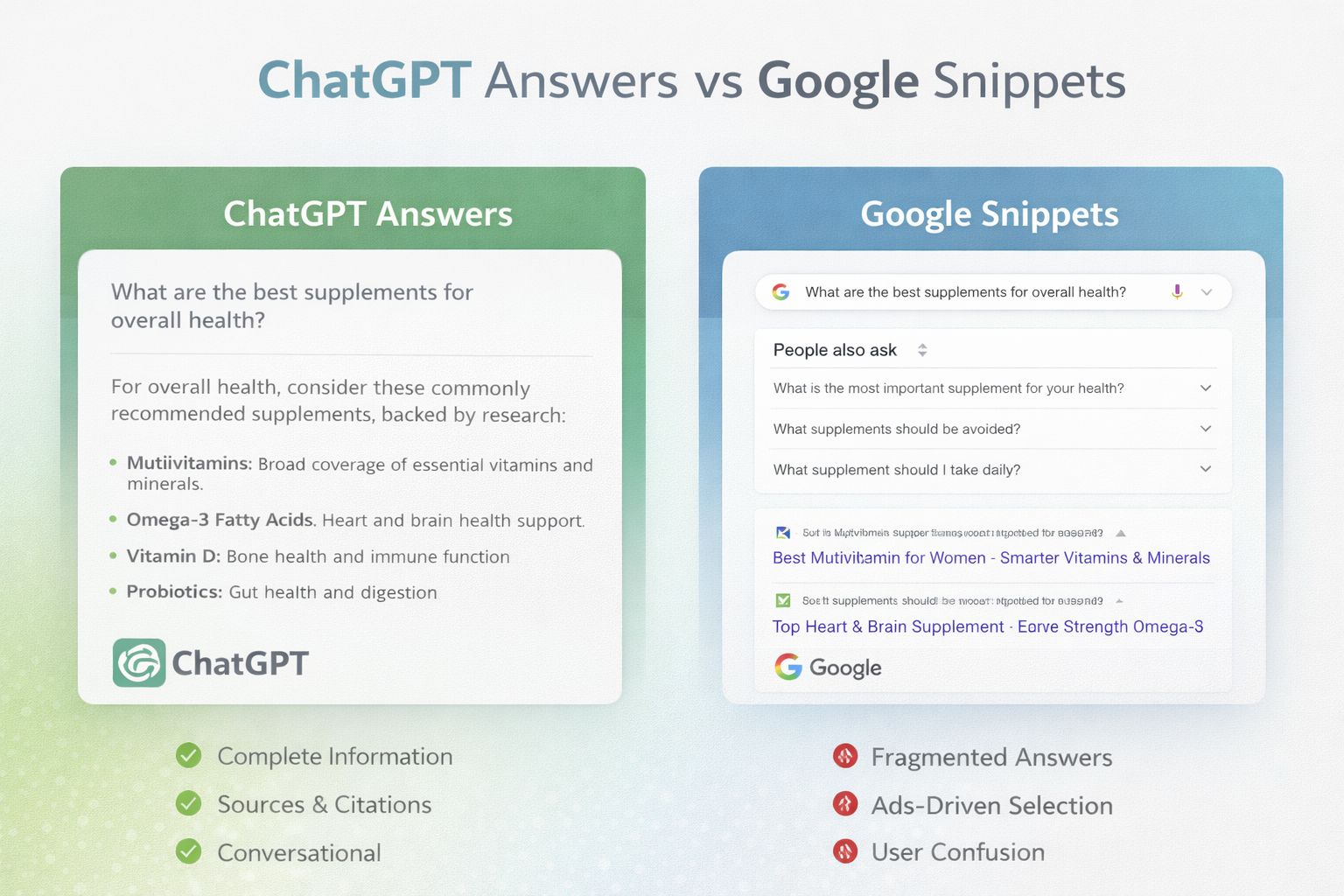
ChatGPT does not merely show fragmented information that is taken from multiple websites. Instead, it analyses the data and crafts a clear and cohesive answer to the question. Users value the conversational style, promptness of follow-up answers, absence of ads, and lack of SEO content. Some pointers are:
- The traditional snippets focus more on ranking signals, while ChatGPT focuses on the relevance of content.
- The traditional snippets often seem generic and provide incomplete or irrelevant results. ChatGPT answers contain summaries, comparisons, reasoning, and actionable insights in a single answer.
- As the answer is more of a one-stop solution, information or answers in multiple links do not need to be looked up in ChatGPT.
- The experience is faster, easier, and more intuitive, which is especially true in the case of complex queries. That is why ChatGPT often performs better in high-intent queries.
Why ChatGPT Feels “Better”
|
Feature |
Google Snippet |
ChatGPT Response |
|
Personalization |
Low |
High |
|
Multi-step reasoning |
Limited |
Strong |
|
Follow-up questions |
Requires a new search |
Seamless |
|
Tone & clarity |
Varies |
Consistent |
|
Bias toward SEO-optimised content |
High |
Low |
Verdict: ChatGPT’s conversational structure makes it a superior choice for understanding, not just searching. While Google remains stronger for time-sensitive queries, ChatGPT dominates in reasoning tasks, reshaping expectations of what “search” should deliver.
Also Read - How to Optimize for Featured Snippets and AI Overviews (Fast & Effectively)
5. The blog highlights a shift toward conversation-first search
The world has changed, and so has technology. Users demand quick, actionable, and conversational responses to queries, rather than scrolling through endless pages of search results. ChatGPT thrives in this area.
What Users Prefer About Conversation-First Search
- Users can learn quickly.
- The following questions are less of a challenge.
- Advertisements are not in the way of the results.
- Decision fatigue is reduced.
- Users are exposed to more relevant directions.
Example: Time Spent to Get an Answer
|
Task |
Google (avg) |
ChatGPT (avg) |
|
Compare two products |
4–6 minutes |
< 30 seconds |
|
Understand a concept |
3–5 minutes |
< 20 seconds |
|
Generate content |
Not possible |
Instant |
Verdict: Users today want instantaneity, user-friendly, and interaction-less experiences. Conversations-first search is therefore perfectly suited for these users. As this kind of user experience is becoming the standard, older search engines will become obsolete if they do not modernise themselves for the newer internet user.
Also Read - How to Rank on ChatGPT: Proven SEO Strategies for AI-Powered Search in 2026
Final Thoughts: The Future Is Hybrid, Not Binary
SearchGPT isn’t the only innovation. ChatGPT rolled out Explore GPTs on January 10, 2024, enabling users to create custom bots. While early usage peaked, it then plateaued to about 2 custom GPTs per user per month. This shows user experimentation and deeper engagement with generative tools beyond simple search.
As we move forward, we look towards a more enhanced and customised search, which is more personable, and ChatGPT leads the pack. Shifting preference is apparent, leaning towards technologies that can provide direct, concise, and highly actionable results. Providing too much information without context, ChatGPT responds with simplicity. Engagement and data parfait it, confirming that searches that provide artificial intelligence are a game-changer in how searches can be utilised. In the future, we can expect a more defined hybrid search environment with the use of Chat GPT and searching operating systems, where both can provide different required elements, and where both can provide a balanced answer to the user's needs.
For brands and marketers, the opportunity isn’t choosing between Google or ChatGPT, it’s learning how to be discoverable, trusted, and cited across both.
AI-powered search is not replacing search it’s evolving it.
Frequently Asked Questions (FAQs)
Q. Is ChatGPT replacing Google Search?
No. ChatGPT is not replacing Google but complementing it. Google remains dominant for navigational, local, and real-time searches, while ChatGPT excels at complex, high-intent, and reasoning-based queries. The future of search is hybrid, not competitive.
Q. How is ChatGPT changing user search behaviour?
ChatGPT shifts search behaviour from link-based exploration to intent-driven answers. Users increasingly rely on conversational AI for explanations, comparisons, summaries, and decision-making tasks, reducing the need to open multiple search results.
Q. Does ChatGPT reduce website traffic?
ChatGPT does not eliminate traffic it filters it. While users may click fewer links, the traffic sent from ChatGPT is typically higher intent and better qualified, especially for e-commerce, education, news, and technical content.
Q. What types of searches are better suited for ChatGPT?
ChatGPT performs best for:
- Explanations and summaries
- Product and service comparisons
- Coding and technical troubleshooting
- Writing and content generation
- Business and decision support queries
Simple fact-finding and time-sensitive searches still perform better on Google.
Q. Why do users trust ChatGPT more for complex queries?
Users trust ChatGPT because it provides structured, contextual, and self-sufficient answers. Unlike traditional snippets, ChatGPT synthesises information, explains reasoning, and allows seamless follow-up questions all in one interface.
Q. How is ChatGPT different from Google featured snippets?
Google featured snippets extract fragments from web pages, while ChatGPT generates cohesive answers by analysing multiple sources. ChatGPT focuses on relevance and clarity, whereas snippets are often influenced by page structure and ranking signals.
Q. Can businesses optimise content for ChatGPT search?
Yes. Businesses can optimise for ChatGPT by focusing on:
- Clear, authoritative content
- Structured explanations
- Natural language answers
- Strong topical authority
- EEAT-aligned writing
This approach is often referred to as AI SEO, AEO, or Generative Engine Optimisation (GEO).
Q. Which industries benefit most from ChatGPT-driven traffic?
Industries seeing the most benefit include:
- E-commerce
- News & media
- Education & research
- SaaS & technology
- Travel and local services
These sectors attract users seeking context, validation, and deeper understanding before making decisions.
Q. What is conversation-first search?
Conversation-first search prioritises natural dialogue, context, and follow-up interactions over keyword-based queries. Instead of multiple searches, users get answers through an ongoing conversation reducing friction and decision fatigue.
Q. What does the future of search look like?
The future of search is hybrid. Traditional search engines will continue powering discovery and freshness, while AI tools like ChatGPT will handle reasoning, synthesis, and intent resolution. Successful brands will be visible across both.
