

Artificial intelligence is transforming how people search, discover, and consume information online. At the centre of this transformation are Large Language Models (LLMs), powerful AI systems that understand, generate, and interpret human language at scale. As AI-driven search engines become more advanced, traditional SEO is evolving into a new paradigm known as LLM SEO.
Table of Content
- What Is LLM?
- Examples of LLMs and Definition
- Principal Features of LLMs
- Main Features of LLMs
- The Progress of Searches: From Simple Keywords to Understanding AI
- Traditional SEO vs LLM SEO
- How LLMs Are Changing SEO
- Why LLM SEO Is the Future of Digital Marketing
- How to Optimize Content for LLM SEO
- The Real World LLM Impact on SEO
- The Difficulties of LLM SEO
- SEO and LLMs
- Conclusion: The Impact of LLM on SEO
- FAQs About LLM
In this blog, we’ll explore what LLMs are, what LLMs are in AI, how large language model AI works, and how LLMs are reshaping SEO strategies for the future of search.
What is LLM?

An example of artificial intelligence is Large Language Models (LLMs), which are sophisticated systems of AI with the ability to understand, generate and respond to human languages. This ability is achieved by training the model on large amounts of textual data. LLMs utilize deep learning and neural networks in order to formulate and create text sequences (i.e. words and sentences) in a manner that is natural as well as contextually aware.
To put this more simply,
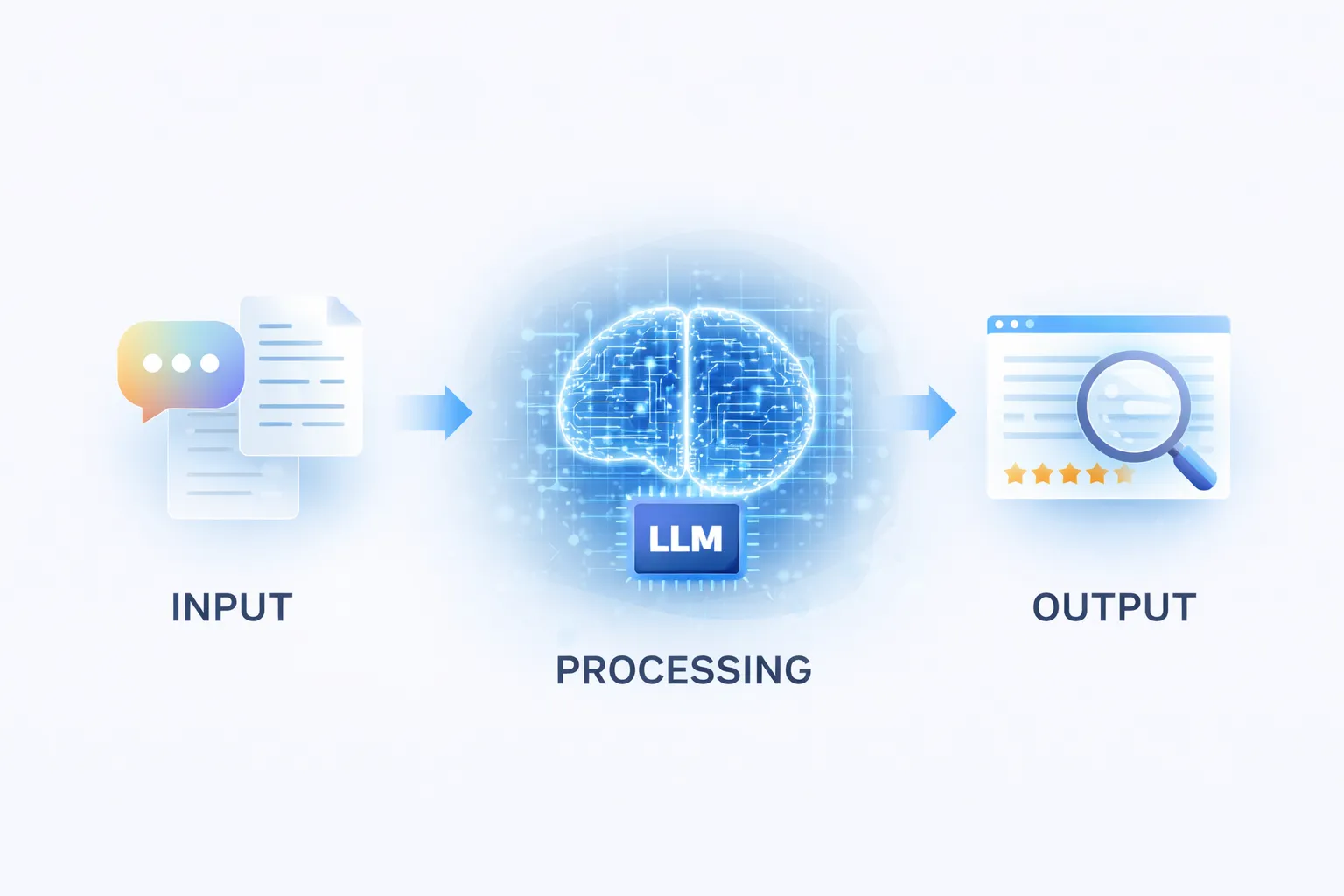
It is an AI model that is capable of reading, writing, and providing a summary, translation, and reasoning service using the language. LLMs power programs such as ChatGPT, Gemini, Claude, and other innovative content generation and search engine AIs.
Examples of LLMs and Definition

To understand LLMs in the field of artificial intelligence, we must analyze the way AI interprets language and processes information.
The AI employs LLMs with transformer architectures that help in the following ways:
- The AI interprets and understands the intent of the user.
- The AI understands the relationships between words and other relevant topics.
- The AI generates responses and behaves like a human.
- The AI is able to analyse and understand complicated questions.
Unlike traditional models of AI, large language models do more than just match a keyword with a response; they understand the meaning of the words.
Principal Features of LLMs
- Large scale of acquired training data (number of words in billions and/or trillions)
- AI has an understanding of context
- AI is able to communicate in multiple languages
- AI is able to reason and summarize
- AI has the ability to learn and adjust
The significant change of LLMs from keyword-based systems to meaning-based systems has radically transformed the field of search engine optimization.
The operation of large language models
A large language model generates responses using the probabilities of words in the data, thus predicting the next likely word in a given input.
Main Features of LLMs

- Training Data: Examples include – books, articles, websites, conversations
- Neural Networks: Language processing deep learning models
- Transformers: Framework that allows understanding of context
- Fine-tuning: Adjusting a model to a particular use case
Simple Example of a Workflow
| Step | Process |
|---|---|
| Input | User query or text |
| Analysis | Context and intent interpretation |
| Processing | Pattern recognition and prediction |
| Output | AI-generated response |
This is what makes LLMs unique and disruptive for SEO, understanding intent rather than keywords.
The Progress of Searches: From Simple Keywords to Understanding AI
The early search engines were reliant on keywords, backlinks, and technical SEO. AI-powered search is altering the criteria for how information is ranked and how it is presented.
Traditional SEO vs LLM SEO
| Aspect | Traditional SEO | LLM SEO |
|---|---|---|
| Focus | Keywords | Context & intent |
| Ranking Factors | Links, keywords, metadata | Topical authority, relevance, semantic meaning |
| Content Strategy | Keyword-focused articles | Topic clusters and knowledge depth |
| User Experience | Page-based | Conversational and contextual |
| Search Results | Blue links | AI-generated answers |
The emerging trends showcase the beginnings of LLM SEO, which demands the optimisation of content for AI in addition to search engines.
How LLMs Are Changing SEO

1. From Keywords to Meaning
LLMs comprehend meaning. That’s why keyword stuffing is ineffective; content must serve the user’s intent and offer scope for thorough answers.
Take, for example,
- Old SEO: "best laptop under 50000” repeated multiple times
- LLM SEO: A well-crafted guide reviewing laptops, detailing their features, and addressing user queries
2. The Growth of Conversational Search
The new generation of AI-based search engines gives answers more conversationally. People pose questions like:
- What is the best diet to follow to lose weight?
- How does digital marketing work?
- Describe SEO to me like I am five.
These kinds of queries and answers are new in comparison to the search engines we are used to. The focus of search engines has shifted away from traditional search results.
This means that content needs to be:
- Straightforward
- Relational
- Conversational
- Prompted for AI to comprehend
3. The Value of Topical Authority
As a result of the new generation of search engines, we are unable to evaluate the authority of a website in a given niche solely based on individual pages. Instead of ranking individual pages, AI analyzes topically relevant content as a whole. To establish topical authority, companies should be focused on creating:
- Pillar content
- Supporting content
- Interrelated topical clusters
This is an integral part of LLM SEO.
4. The Necessity of Semantic SEO
Rather than concentrating solely on a single focused keyword, Semantic SEO is centered around a combination of interconnected concepts, entities, and subjects.
For example, consider the subject of Digital Marketing, LLMs would expect to see content that discusses:
- SEO
- Social Media Marketing
- Content Marketing
- Pay Per Click Advertising
- Analytics
- Branding
When search engines start to reward content centered around an idea as opposed to a single keyword, we are rewarding content that shows depth.
5. Search Results from AI
Since the advent of AI development, search engines have started to use LLMs to formulate responses directly within the search page. This results in
- searches with no clicks
- less web traffic from searches lacking specificity
- increase in importance of premium, credible web pages
In order to establish a competitive edge, companies must generate web pages with content that AI algorithms will reference.
Why LLM SEO Is the Future of Digital Marketing

1. User Intent More Than Keywords
LLMs have a stronger inclination for intent. This means content must resolve a problem and must not be focused on the keywords.
2. Depth Over Volume
It is better to have one, single, comprehensive piece of content than to have countless amounts of less informative content and posts.
3. Trust and Expertise
Credibility is a must-ranked factor for AI models. This results in the need for expertise and quality for content.
4. Multi-Platform Visibility
Not only do LLMs power search engines but also:
- Voice Assistants
- AI Tools
- Knowledge Tools
- Chatbots
This means that the scope of SEO can extend beyond Google.
How to Optimize Content for LLM SEO
1. Build Topic Clusters
Instead of isolated keywords, create a range of content that represents a comprehensive picture of a single topic.
Example structure:
Pillar Topic: Health Coaching
- What is health coaching
- Benefits of health coaching
- Health coaching certification
- Career opportunities
- Client acquisition strategies
This structure helps the AI understand topical depth.
2. Focus on E-E-A-T
Because of the nature of your query and its proximity to Google’s E-E-A-T (Experience, Expertise, Authoritativeness and Trustworthiness) guidelines, it corresponds to how LLMs are evaluated.
To improve the E-E-A-T:
- Showcase author’s credentials
- Incorporate data and citations
- Share actionable tips
- Ensure content is factual and accurate
3. Use Natural Language
Use a more relaxed and conversational vocabulary that mimics how your audience would phrase their questions.
For example,
- Instead of: “LLM SEO strategy implementation”
- Use: “How to optimise content for LLM-driven search”
4. Answer Questions Clearly
When content provides a direct response to a question, LLMs prioritise this type of content.
Use:
- FAQs
- Bullet points
- Clear headings
- Structured explanations
5. Optimising for Entities & Concepts
The LLMs learn and recognise a list of brands, people, and entities.
Example:
- Naturally mention related and familiar topics and phrases
- Logically thread ideas together
- Refrain from keyword stuffing
The Real World LLM Impact on SEO
Case Study: The Content Stream Shift
Pre LLMs
-
Keyword-centric blogs
-
Succinct articles
-
Strategies drenched in backlinks
Post LLMs
-
Comprehensive guides
-
Clusters of topics
-
Content for the target audience
-
Structure that AI will recognise
Key Metrics
-
Increased topical authority
-
Heightened engagement
-
Enhanced visibility within AI search
-
Sustained organic growth
The Difficulties of LLM SEO
There are both pros and cons to LLMs.
- Declining Organic Clicks: AI-generated responses keep users from visiting the sites.
- Heightened Competition: Quality content must be produced to be seen.
- Outdated Optimisation: There’s a need for a better understanding of AI and user behaviour.
- Content Overload: An influx of brands creating long, authoritative content.
SEO and LLMs
The evolution of SEO is based on smarter search queries.
Key Trends
- AI-powered search engines replacing traditional search
- Conversational AI driven search engines
- Increased focus on authority and expertise
- Content strategy and branding integration
- Expanding LLM SEO within the digital marketing discipline
In the next few years, those capable of coping with LLM-driven searches will possess a huge competitive advantage.
Also Read - Best AI SEO Tools in 2026: Smarter Optimisation with AI-Powered Strategies
Conclusion: The Impact of LLM on SEO
Knowledge of LLM, LLM in AI, large language models, and AI is necessary to do SEO in the modern world. LLMs are generating new ways of content creation, ranking, and consumption.
Brands need to go beyond conventional SEO and adopt LLM SEO strategies centred on intent, authority, and content that matters to succeed in the new age of AI. Early adopters will survive and thrive in the AI search era.
FAQs About LLM
Q1. How are LLMs different from traditional search algorithms?
Ans. LLMs go beyond keyword matching and focus on understanding context, intent, and meaning. Unlike traditional search algorithms that rank pages based on keywords and links, LLMs analyse content depth, relevance, and relationships between topics, making search results more conversational, accurate, and user-focused.
Q2. Do LLMs replace Google SEO completely?
Ans. No, LLMs do not replace Google SEO but transform it. Traditional SEO still matters, but it must evolve to align with AI-driven search. Businesses now need to focus on topical authority, semantic relevance, and user intent to stay visible in both traditional and AI-powered search environments.
Q3. How can businesses adapt their SEO strategy for LLM-driven search?
Ans. Businesses should shift from keyword-focused content to topic-based content strategies. Creating pillar pages, topic clusters, FAQs, and authoritative resources helps AI models understand expertise. Optimising content for clarity, depth, and real user questions is essential for effective LLM SEO.
Q4. Can LLMs generate content that ranks well on search engines?
Ans. Yes, LLM-generated content can rank well if it is accurate, original, and valuable to users. However, search engines prioritise quality, expertise, and trustworthiness. Human editing, strategic structuring, and real-world insights are crucial to ensure AI-generated content meets SEO and credibility standards.
Q5. Why is topical authority important in LLM SEO?
Ans. Topical authority helps AI models identify credible sources on specific subjects. When a website consistently covers related topics in depth, LLMs recognise it as an expert resource. This improves visibility in AI search results and strengthens long-term organic performance in LLM-driven SEO.
