

Search is not simply ranking blue links. AI platforms like ChatGPT, Google AI Overviews, and other generative engines modify how people find data, and therefore, brands need to consider how content is created and structured. Here is where LLM optimisation or LLMO comes in.
Table of Content
- What Are Large Language Models (LLMs)?
- How LLM Works? (In Simple Terms)
- What Is LLM Optimisation (LLMO)?
- Key Differences between LLMO and Traditional SEO
- Importance of LLM Friendly Content 2026
- Principles of LLM-Friendly Content
- Creating Content for LLMs
- Content Structure Preferred by LLMs
- Authority and Trust in LLMO
- How LLMO Impacts SEO Results
- Managing LLMO Mistakes
- Concluding Remarks
Large Language Models do not ‘‘rank’’ content like search engines do. They understand, summarise, and cite information regarding the clarity, authority, and context of the content. If a piece of content is not created in a way that AI can interpret it, then it is at risk of becoming ignored in AI-powered replies.
In this piece, we will examine what large language models are, how LLMs work, and how to create LLM-friendly content in a way that increases trust and digital visibility.
What Are Large Language Models (LLMs)?
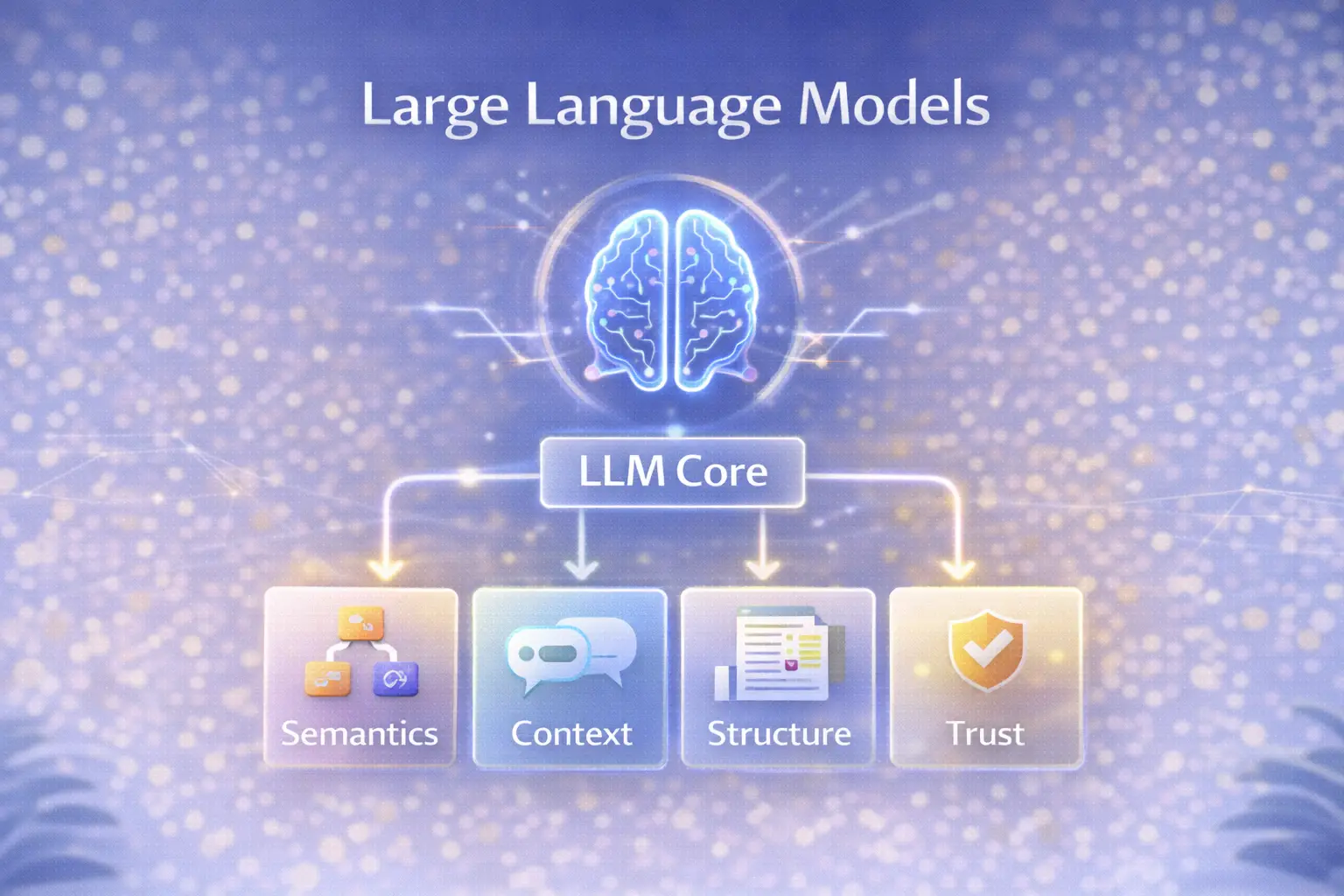
Large language models are AIs that have been trained to interpret a range of languages, frameworks, and the intent of the language. Some examples of models include the GPT systems, Claude, and Gemini, along with many other enterprise-level AIs. Unlike traditional algorithms, which depend on keywords and backlinks, LLMs consider more holistic factors like:
- Semantics
- Context
- Content structure
- Trustworthiness
This means that brands have to move on from mere keyword stuffing to depth, clarity and credibility, principles of large language model optimisation.
How LLM Works? (In Simple Terms)
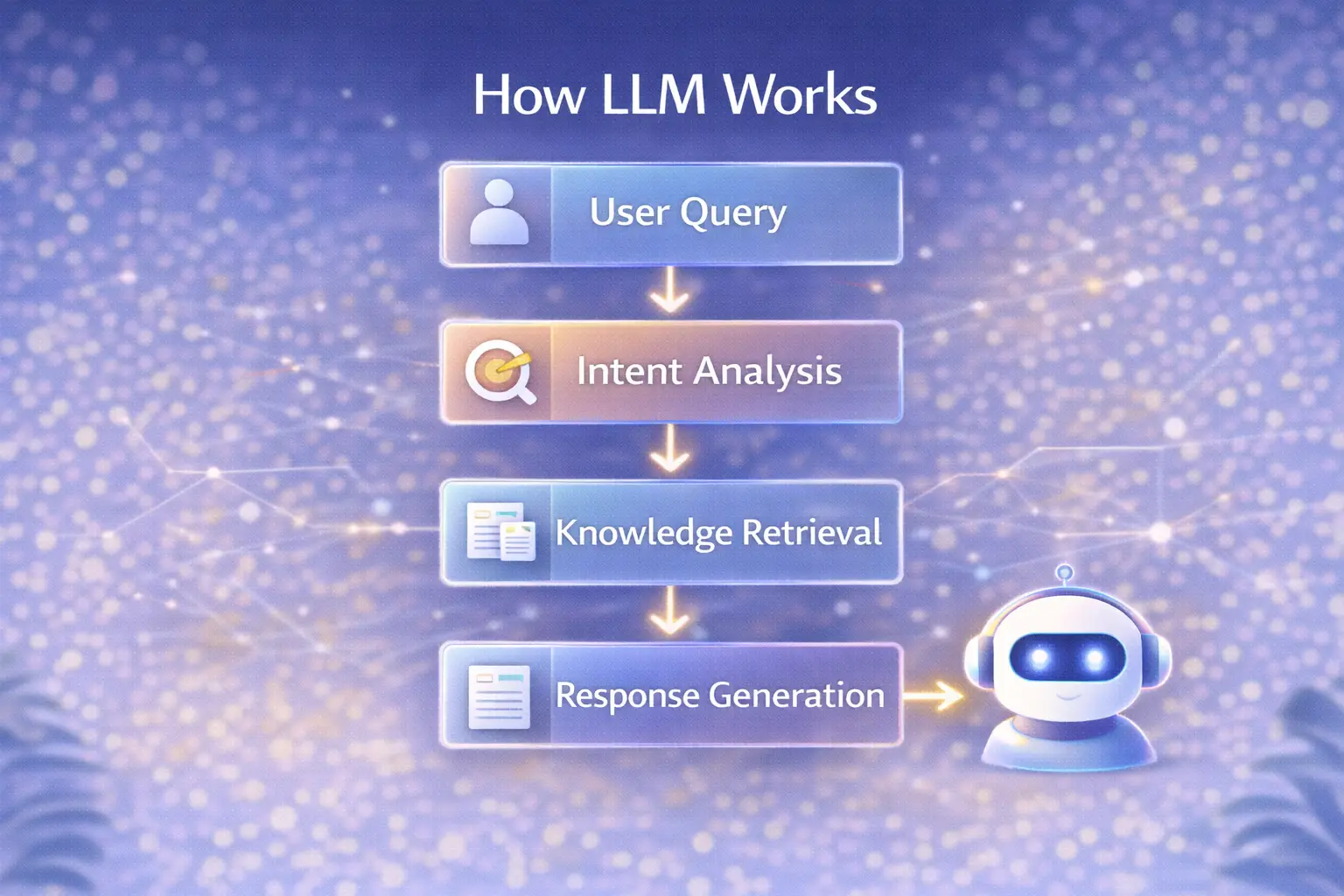
Answering how LLM works helps clarify why LLMO matters.
Machine LLMs do the following to generate a response to the user’s question:
- Identify user’s intent
- Develop a relevant response
- Retrieve information from a reliable, structured source
- Formulate a response based on a pattern of language that is guided by probability
Unlike traditional search engines that rank webpages, LLMs provide answers by referencing, summarising, and citing previous work. This is what makes contextual clarity and authoritative framing important.
What Is LLM Optimisation (LLMO)?
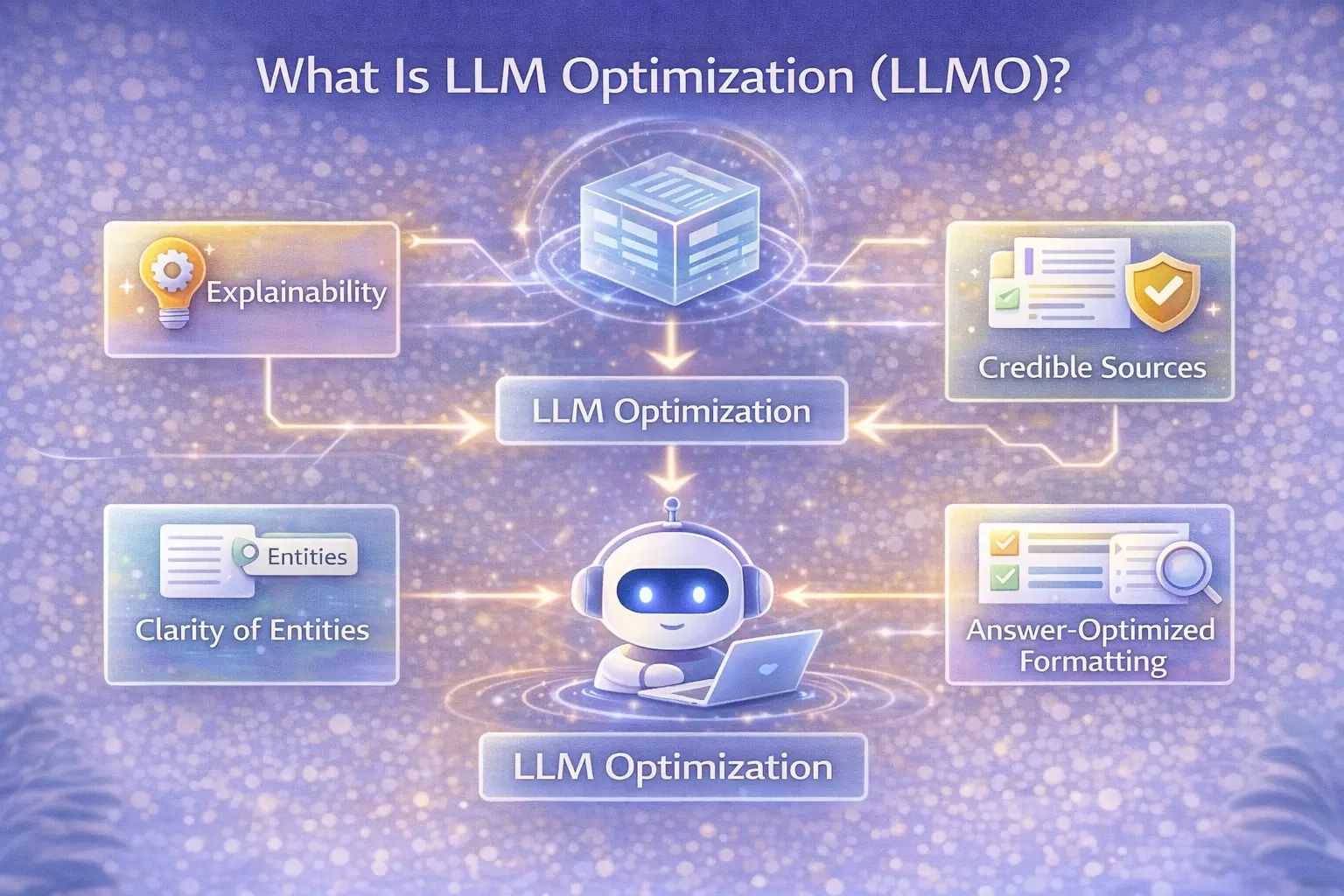
LLMO is a comprehensive concept that is concerned with the structuring, writing, and publishing of content that large language models can understand, trust, and rely on.
While LLMO SEO is similar to traditional SEO, it differs from it in the following:
- Explainability
- Clarity of Entities
- Credible Sources
- Answer-Optimised Formatting
In LLMO, the primary focus is to create content that LLM can understand rather than to improve the page’s ranking.
Key Differences between LLMO and Traditional SEO
| Aspect | Traditional SEO | LLM Optimisation |
|---|---|---|
| Focus | Rankings & clicks | AI comprehension |
| Keywords | High importance | Contextual relevance |
| Structure | Helpful | Essential |
| Citations | Backlinks | Content credibility |
| Goal | Traffic | AI visibility |
This evolution doesn’t replace SEO; it extends it.
Importance of LLM Friendly Content 2026
In the future, AI assistants will likely be the first point of discovery, and LLM-friendly content will be the first determinant of:
- Whether or not the AI includes your brand
- How well the AI conveys the expertise of your brand
- Whether the AI trusts your content or disregards it
In a lot of fields, AI answers already eliminate the need for users to visit sites directly, making brand mentions, citations, and authority more important than simply having a lot of clicks.
Principles of LLM-Friendly Content
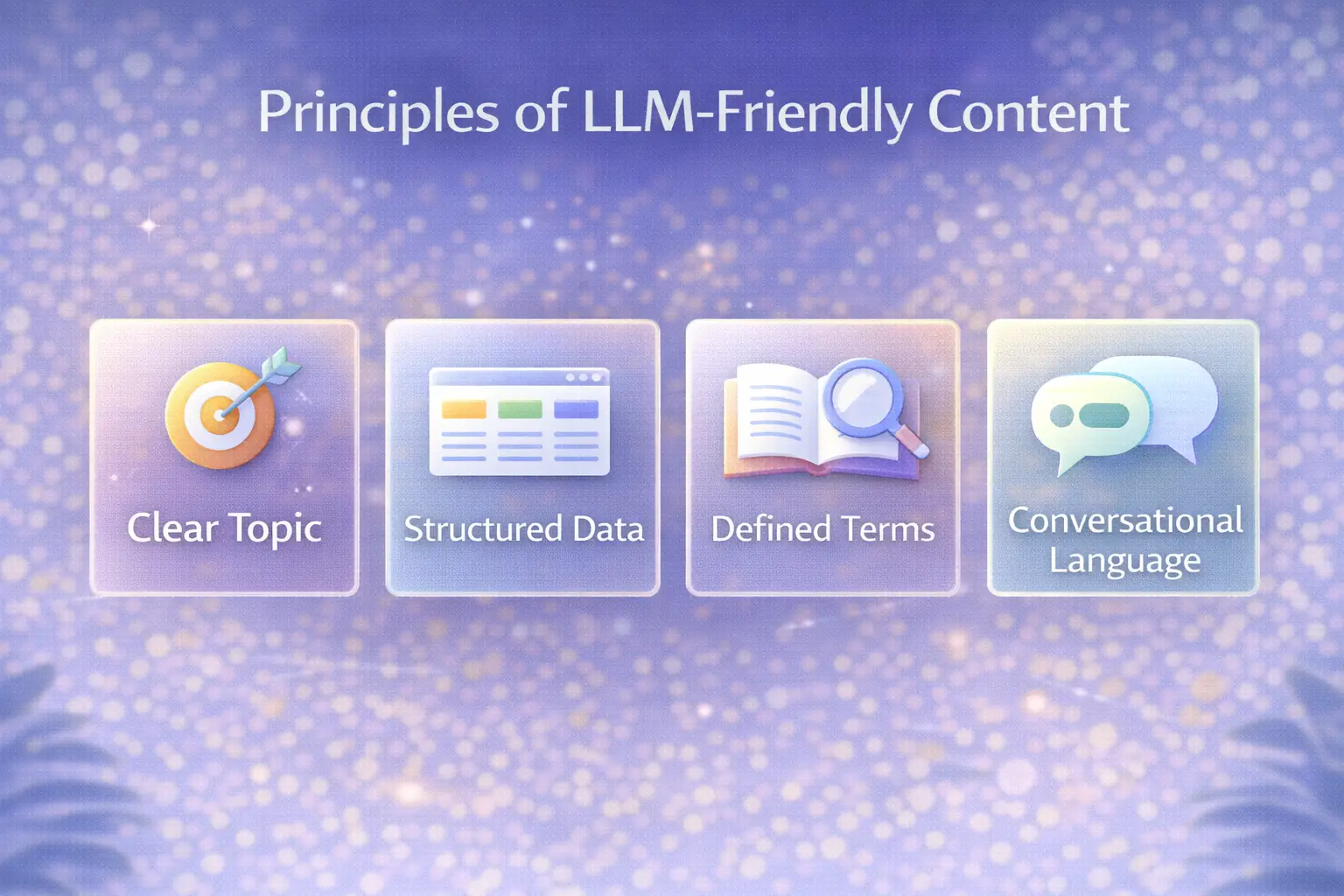
1. Focus on a single clear topic
Each page should address 1 central topic. Mixing different ideas is confusing to the reader.
2. Use structured information
This includes:
- Tables
- Bullet lists
- H2 to H4 Headings
- Step-by-step instructions
These formats are generally more predictable and are preferred by large language models.
3. Defining Terms
Defining concepts early is especially important when explaining what a large language model or any related industry jargon.
4. Use of Everyday Language
Utilising a conversational tone rather than a stiff, formal tone improves human and AI comprehension.
Creating Content for LLMs
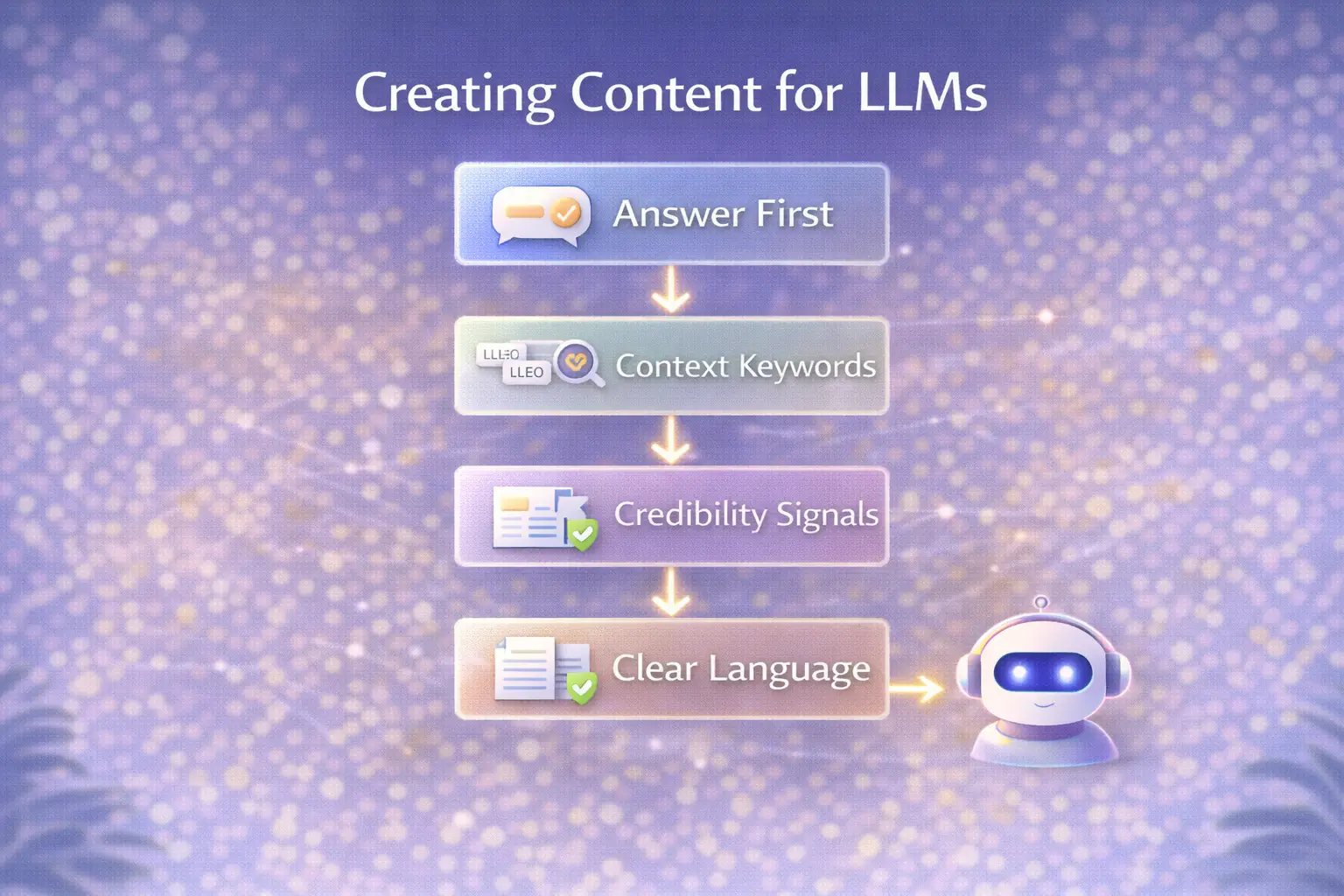
Use the Answer-first Technique
Lead with the answer before explaining further, as LLMs prefer clear and straightforward responses.
Contextual Keywords
Use LLMO, LLMO SEO, and large language model optimisation in context, meaning without being redundant.
Show Credibility
Show credibility with the audience using:
- Citation of data
- Relevant examples
- Correct use of industry jargon
Be Clear
Be clear when using pronouns, make claims that are specific, and avoid mixed messaging.
Content Structure Preferred by LLMs
- Explainer articles
- Guides
- FAQs
- Comparison tables
- Glossaries
AI is able to find and retrieve the information faster and easier using these structures.
Also Read - What Is Schema Markup & How to Boost Your SEO by Using Schema Markup
Authority and Trust in LLMO
LLMs favour information that is:
- From the same source repeatedly, and is mostly correct
- Shows the authority of the sub-topic
This makes brand consistency and topical depth prominent elements in LLMO strategies.
How LLMO Impacts SEO Results
LLMO SEO adds to optimisation efforts by:
- Strengthening content comprehension
- Building topical credibility
- Boosting the potential of AI references
- Assisting zero-click opportunities
Early adopters win sustained discoverability as shifts in search behaviour occur.
Managing LLMO Mistakes
Not Writing for People but the Bots
One of the biggest LLMO mistakes is prioritising algorithms over human readers. Large language models are designed to mirror how people understand language, not reward robotic phrasing. Content that sounds unnatural, repetitive, or overly optimised reduces clarity and trust. When content is written for real users, with clear explanations, natural flow, and meaningful insights, LLMs are more likely to interpret it accurately and reuse it in AI-generated responses.
Keyword Stuffing
Keyword stuffing confuses both readers and language models. Repeating terms excessively breaks context, reduces readability, and signals low-quality intent. LLMs evaluate semantic meaning rather than raw frequency, so unnatural repetition actually weakens content comprehension. Instead, using keywords naturally within well-structured explanations helps LLMs understand topical relevance without misinterpreting the content as spammy or manipulative.
Leaving Out Substantive Content
Thin content may rank briefly, but it fails in LLM environments. Large language models prefer depth, clarity, and complete explanations. When articles lack real insights, examples, or actionable information, LLMs have little value in extracting or citing them. Substantive content demonstrates expertise and gives AI systems enough context to summarise, quote, or reference accurately in responses.
Bad Structuring of the Content
Poor structure makes content difficult for LLMs to interpret. Without clear headings, logical flow, and organised sections, AI struggles to identify key points. Well-structured content, using headings, bullet points, and concise paragraphs, helps language models understand the relationships between ideas, improving the chances of accurate summarisation and citation in AI-driven search results.
Not Enough Backlinks to Establish Authority
While LLMs don’t rank pages traditionally, authority still matters. A lack of credible backlinks can weaken trust signals around your content. Backlinks from relevant, authoritative sources reinforce expertise and reliability, helping LLMs prioritise your content when generating answers. Authority acts as a confidence layer, supporting both traditional SEO and long-term LLM visibility.
It’s no overstatement to say quality, not shortcuts, is rewarded by LLMs.
Also Read - Human-First Content vs AI SERPs: What Google Isn’t Addressing Yet
Concluding Remarks
Today’s brands are seizing the opportunity to shape how AI understands information, cementing their visibility for the future. When large language models dominate the search experience, the incorporation of LLM optimisation is vital to building the new digital framework. The most effective way to represent your expertise, build trust, and allow your content to be appropriately reused and referenced is to generate LLM-friendly content.
Structuring your content with the AI’s needs and the audience’s requirements in mind will allow your business to stay relevant. Prioritising adapting to new information consumption behaviours, rather than focusing on current trends, will increase your future value. Those brands that are prepared today will be the ones to shape the future.
FAQs About LLM optimization
Q1. How is LLM optimization different from traditional SEO?
Ans. LLM optimization focuses on how large language models understand, summarise, and reuse content, rather than how search engines rank pages. While traditional SEO prioritises keywords and backlinks, LLMO emphasises clarity, structure, context, and authority so content can be accurately interpreted and cited in AI-generated answers.
Q2. Can LLM-friendly content improve visibility even without high search rankings?
Ans.Yes. LLM-friendly content can appear in AI-generated responses even if it doesn’t rank on the first page of search results. Language models often pull information from well-structured, authoritative sources, meaning visibility increasingly depends on content quality and clarity rather than rankings alone.
Q3. Do large language models prefer long-form or short-form content?
Ans.LLMs don’t prefer length; they prefer completeness. Content should be long enough to explain a topic clearly, define key concepts, and provide useful context. Well-organised long-form content often performs better because it gives LLMs more accurate information to extract and summarise.
Q4. How important is content structure for LLM optimisation?
Ans.Content structure is critical for LLM optimisation. Clear headings, logical sections, bullet points, and tables help language models identify key ideas quickly. Poorly structured content increases the risk of misinterpretation or being ignored in AI-generated responses.
Q5. Will LLM optimization replace SEO in the future?
Ans.LLM optimization will not replace SEO but will complement it. As AI-driven discovery grows, SEO ensures discoverability while LLMO ensures comprehension and trust. Brands that integrate both strategies will maintain visibility across traditional search and AI-powered platforms.
